
You want to send cold email, and every thread you read says the same thing: Instantly for sending, Apollo for data. That's true as far as it goes. It just doesn't tell you what either one costs once you're sending real volume.
On the pricing pages the two look close. Instantly's cheapest sending plan is $47 a month; an Apollo Basic seat is $65 billed monthly.
But Apollo bills part of your email setup in the credits you'd spend on contact data. And Instantly saves one feature most teams need for its second plan.
So the answer turns on one number. It isn't your budget.
Prices and limits checked on instantly.ai, apollo.io and both help centres on 4 October 2026, monthly billing unless we say otherwise. We read the docs and did the arithmetic; we didn't send test campaigns or measure either database's accuracy.
Instantly or Apollo: which way does it lean?
For cold email outreach, Instantly. It charges for how much you send, not for how many people send it, and every plan includes unlimited email accounts and unlimited warmup. In the worked example below, a three-person team contacting 3,000 new leads a month pays $194 a month on Instantly against $297 on Apollo.
Apollo wins when outreach means more than email. One seat bundles a contact database, phone numbers, a dialer, call recording and a deal pipeline. And for a single sender, that bundle costs about what Instantly's two plans cost together.
That's the number from the top: how many people on your team send. Before the maths, though, it helps to know what each company is really selling you.
The real difference: a sending engine vs a sales database
Instantly is built around sending, and its pricing shows it. You pay for an Outreach plan, sized by emails per month and contacts loaded. Leads from its database are a second subscription, Instantly Credits, on its own tab of the billing page.
Apollo is built around a contact database. A seat gets you data, sequences, a dialer and a pipeline, paid for with a monthly allowance of credits. Email is one channel of several.
That shows up in the bill in a way most comparisons skip. On Instantly, mailboxes and warmup are flat: connect five accounts or fifty and the price doesn't move. On Apollo, warmup past the first mailbox per seat, and any mailbox you buy in-app, draws on the same credits that buy email addresses.
The Apollo cost hiding in the help centre
Apollo's warmup guide spells it out. Paid plans "typically include warmup for 1 mailbox per seat". Every additional mailbox "uses 200 credits per 30-day billing period", and if the credits aren't there at renewal, Apollo pauses that mailbox's warmup automatically.
Buying mailboxes inside Apollo costs credits too. Its domain and mailbox guide lists 1,500 credits per domain a year. Mailboxes run 300 credits a month for Apollo's own SMTP, 800 for Google Workspace and 1,500 for Microsoft 365, all non-refundable.
Put a dollar figure on that. Professional, billed monthly, is $99 for 4,000 credits, so a credit is worth about 2.5 cents.
That makes a Google Workspace mailbox bought in Apollo worth about $20 a month in credits. Instantly's plans overview prices a done-for-you Google mailbox at $5 a month and a domain at $15 a year.
And you'll need more mailboxes than you think. Apollo's deliverability page calls about 20 emails a day per mailbox a safe start and says not to exceed 50. Instantly recommends 30 campaign emails a day per account.
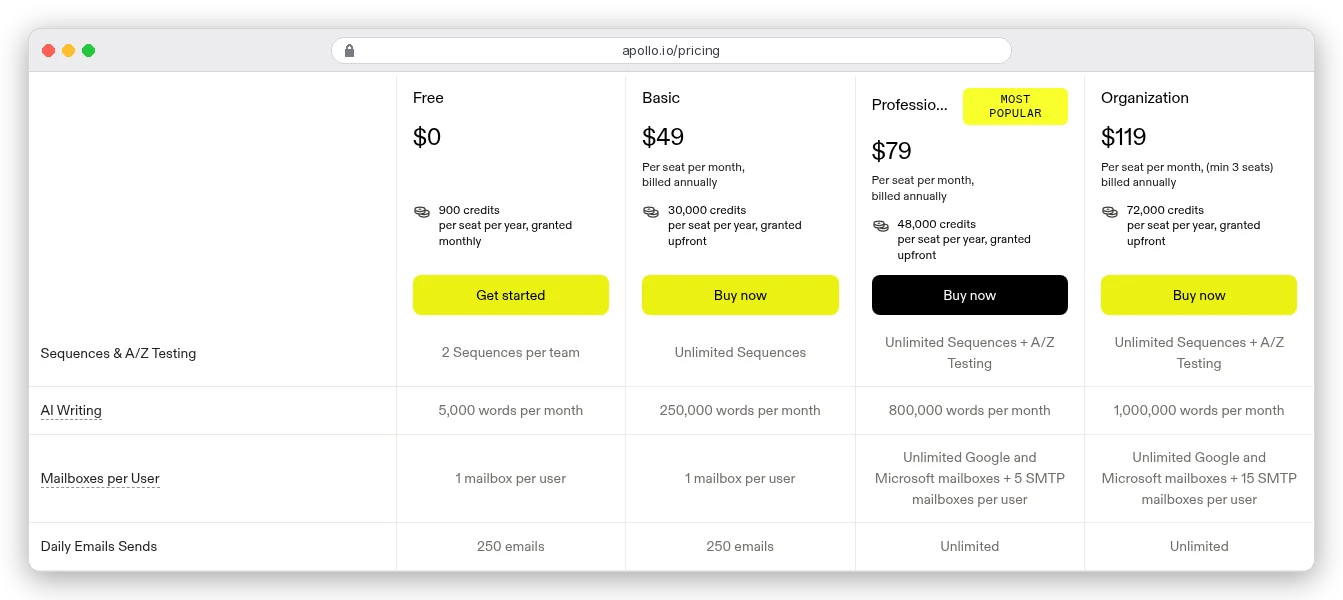
That table hides a second catch. Basic allows one mailbox per user and 250 sends a day.
At 30 a day over 22 weekdays, one mailbox sends about 660 emails a month: roughly 165 new prospects on a four-email sequence. So anyone sending at volume on Apollo ends up on Professional.
What does it cost to contact 1,000 leads a month?
Here's a worked scenario. It's hypothetical, but every input comes from the vendors' published numbers.
Say you want 1,000 new prospects a month, four emails each. That's 4,000 emails, about 180 a weekday, so seven mailboxes per sender at 30 a day. You bring your own mailboxes, which cost the same whichever tool you pick, so we leave them out.
One sender
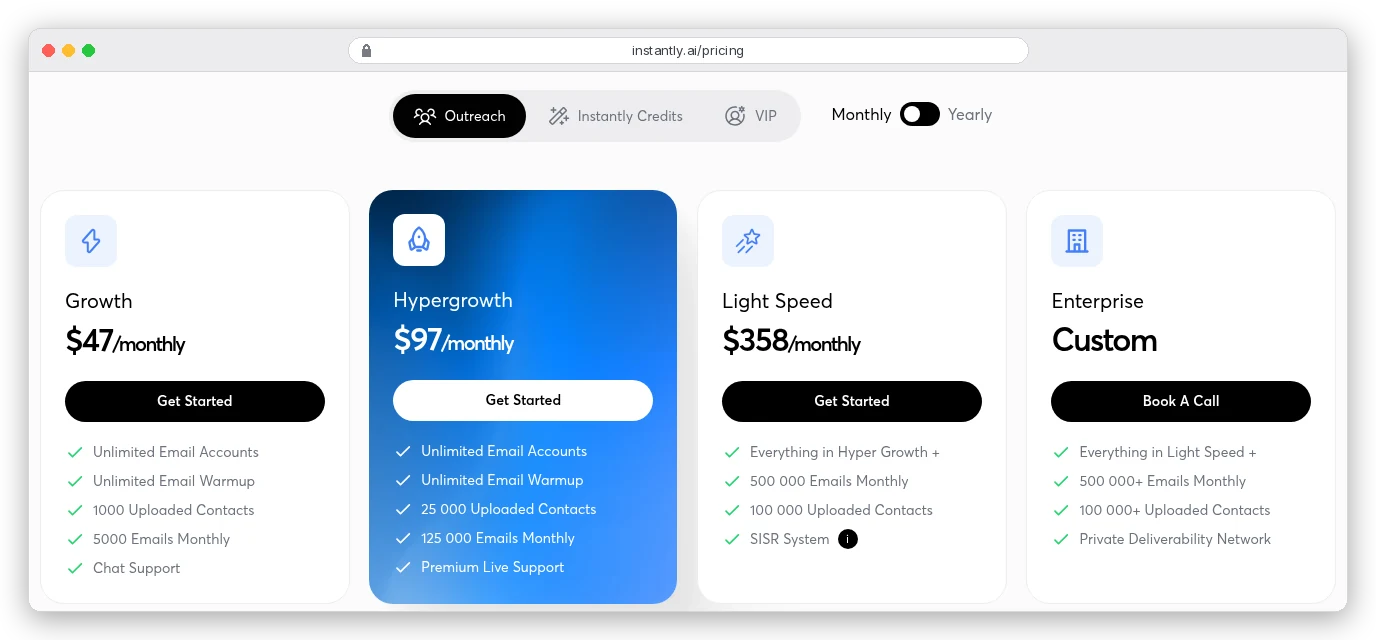
On Instantly, Growth ($47) covers 5,000 emails and 1,000 uploaded contacts. Growth Credits ($47) adds 1,500 credits.
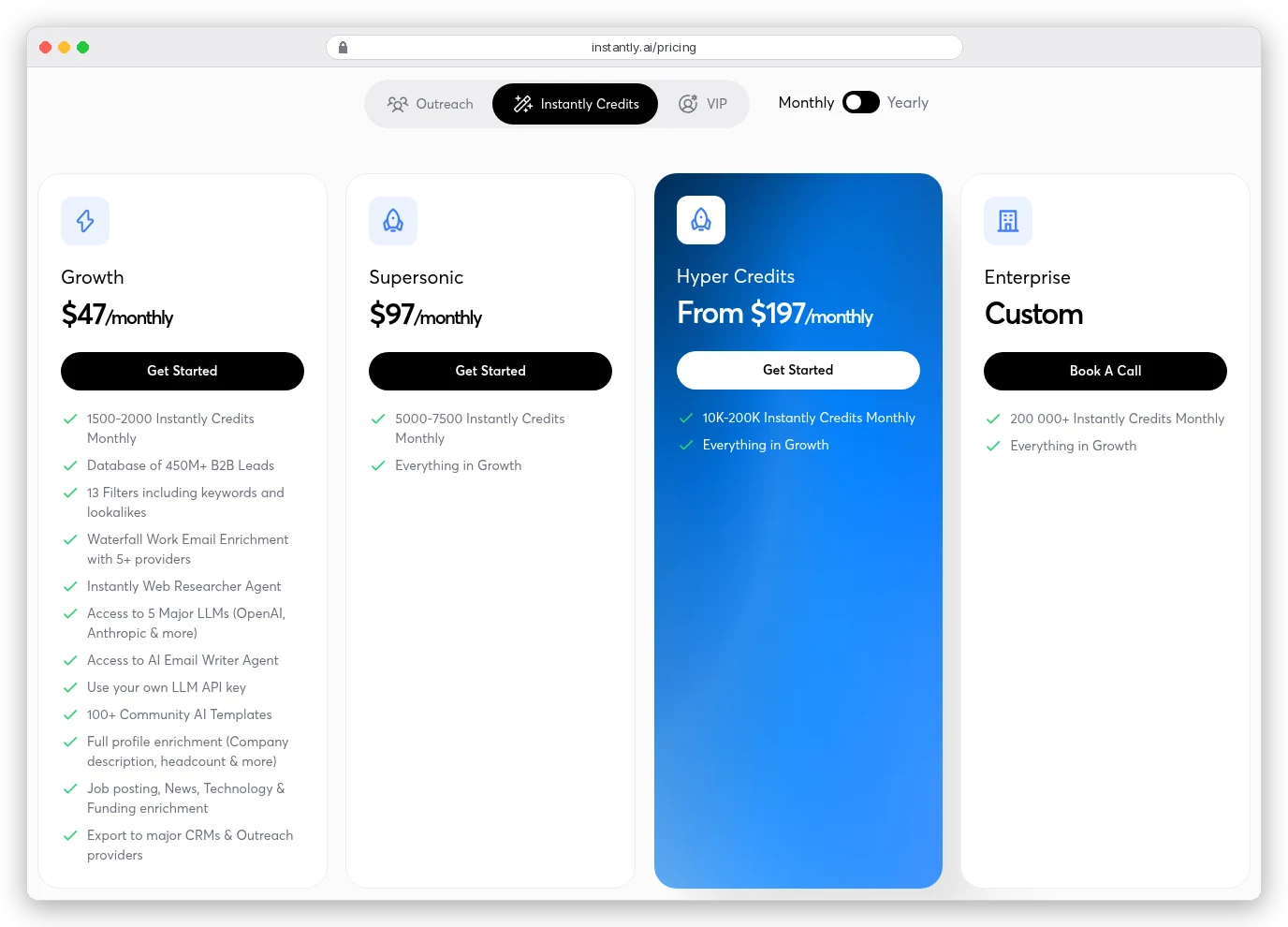
A verified work email costs 1 credit when Instantly finds it and 2 when a data partner does. Its credit table puts the average at about 1.5, so 1,500 credits finds roughly 1,000 emails, with nothing to spare. Total: $94 a month.
On Apollo, Professional ($99) gives 4,000 credits. A thousand email reveals cost 1,000 of them, because Apollo charges at most 1 credit per contact and only for emails it can verify.
Warming the six extra mailboxes costs another 1,200. That leaves 1,800 credits, enough for about 225 phone numbers at 8 credits each. Total: $99 a month.
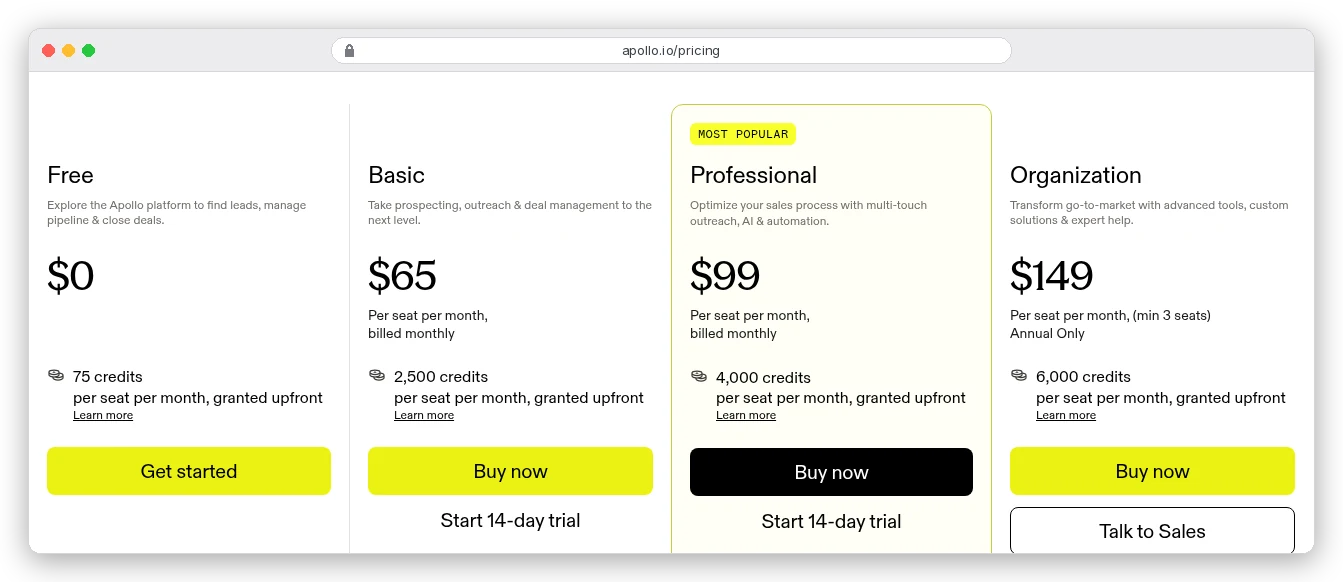
For one person, then, it's close to a tie, and Apollo throws in the dialer, the phone numbers and the pipeline. Billed annually, Apollo Professional drops to $79. Instantly's two plans come to $85 as a bundle or about $75 bought separately, because the page discounts bundles 10% and some single plans 20%.
Three senders
Now triple it: 3,000 prospects, 12,000 emails, about 19 mailboxes. Instantly's Growth plan stops working here, and not because of volume. Inviting team members is only available on Hypergrowth and Light Speed.
Hypergrowth ($97) plus Supersonic credits ($97 for 5,000, enough for about 3,000 emails at the 1.5 average) is $194.
Apollo charges per seat, and every seat on an account has to be on the same plan. Three Professional seats are $297. Their 12,000 credits pool across the team, so the data plus 16 extra warmups (3,200 credits) fit with room left.
| Worked example | Instantly | Apollo |
|---|---|---|
| 1 sender, monthly | $94 | $99 |
| 1 sender, annual | $75-$85 | $79 |
| 3 senders, monthly | $194 | $297 |
| 3 senders, annual | $175 | $237 |
| 5 senders, monthly | $244 | $495 |
The gap widens with every hire, because Apollo's bill is seats times price and Instantly's is volume. At three senders, Instantly works out to about $65 per 1,000 leads contacted and Apollo to $99. At five it's $244 a month against $495.
You're probably thinking those extra Apollo seats buy something. They do: a dialer, call recording minutes and 4,000 more credits each.
If your reps call, that's real value. If they only email, you're paying for tabs nobody opens.
Lead data: which database should you build lists from?
Data is why most people sign up for Apollo. Its pricing page claims 240 million contacts and 30 million companies, with intent filters and job-change enrichment on paid plans. The credit costs are simple: 1 for an email, 8 for a phone number, 1 to 8 for enrichment.
Instantly's database, SuperSearch, claims 450 million-plus B2B leads with 13 filters. It looks up work emails through a waterfall of "5+ providers" and charges nothing when no verified email turns up.
Its credit table covers emails, enrichment, verification at 0.25 credits a lead and AI agents. There's no phone-number reveal on it.
We didn't test either database, and the headline counts aren't measured the same way. Don't read 450 against 240 as "twice the data". Run your own ideal customer profile through both trials before you pay: Apollo's includes 75 credits and Instantly's 100.
One difference you can check without a test is expiry. Apollo's unused credits die at the end of each billing cycle. Instantly's monthly credits last two months, which forgives a slow month.
If phone numbers are part of your outreach, this section decides it on its own. Instantly's database doesn't reveal them.
Sending, warmup and replies
This is Instantly's home ground. Warmup runs through a pool of other Instantly users' inboxes that open and reply to your warmup emails. Instantly suggests 10 warmup emails a day on a new account and at least two weeks before campaigns, three for its own AirMail mailboxes.
Apollo's warmup recommends up to 40 emails a day and a two-week minimum. Its domain-buying guide says six weeks before cold outreach, though, so Apollo's own docs disagree. Plan for the longer one.
Replies are where Instantly's cheap plan pinches. On Growth you can preview replies in Unibox, its shared inbox, but replying from it needs Hypergrowth. Apollo's unified inbox is on every plan, Free included.
Where Apollo falls short
Apollo earns us a commission, so here's the part its sales page won't lead with.
- Seats drive the bill, and you can't mix plans: everyone on the account is on Basic or everyone is on Professional.
- Basic is one mailbox per user and 250 sends a day, which rules it out for volume.
- Warmup past the first mailbox per seat, and any mailbox bought in-app, comes out of your credits. Run out and warmup pauses.
- Credits don't roll over, and add-on credits renew every cycle until you drag the slider back to zero.
- Annual is a lock. You can't drop to monthly mid-term, downgrades aren't refunded, and Organization is annual-only with a three-seat minimum ($357 a month at $119 a seat).
- The free plan connects Gmail mailboxes only.
What Instantly's pricing page doesn't tell you
Instantly has its own fine print, and the first two items tend to bite in month two.
- The uploaded-contact limit is fixed, not monthly. Instantly's plan comparison says it "counts any contacts in the campaign (active or paused)" and does "not reset every month". On Growth that's 1,000, so month two means deleting month one's leads.
- No team logins below Hypergrowth, and no replying from Unibox either.
- Data is a second subscription. A credits-only account can upload just 250 leads to campaigns.
- Calls and SMS live in a separate CRM plan ($47 or $97 a month), with phone credit bought on top.
- The pricing page contradicts itself. Hypergrowth shows 125,000 emails a month on the monthly toggle and 100,000 on the yearly toggle and in its own compare table. That table and the help centre's also disagree on whether Growth gets A/Z testing and the API. Ask support before you count on either.
Can you use both?
Plenty of teams do: build and verify the list in Apollo, send it from Instantly. For one sender, Apollo Basic ($65, 2,500 credits) plus Instantly Growth ($47) is $112 a month. That's $18 more than Instantly alone, and it buys Apollo's filters plus enough spare credits for about 187 phone numbers.
Check two things first. Apollo says exporting saved contacts to CSV "may require export credits, depending on your Apollo plan". And Instantly's 1,000-contact cap on Growth applies wherever the list came from.
Our step-by-step Apollo lead guide covers how to filter a list small enough to be worth that money.
If your prospects live in directories or on maps rather than in a B2B database, scraping can beat both. Our Apify review covers ready-made scrapers for that, and the Firecrawl review covers turning prospects' websites into research notes for a first line.
Which one should you pick?
- You only email, alone or with a team: Instantly. Start on Growth plus Growth Credits ($94) and move to Hypergrowth the day a second person needs a login.
- You're one seller who also calls: Apollo Professional. At $99 it costs about what Instantly does and adds phone numbers, a dialer and a pipeline. Skip Basic if you send more than about 650 emails a month.
- Three or more reps who mostly email: Instantly, by about $100 a month at three seats and $250 at five.
- Reps who call and email from one system: Apollo, with credits budgeted for warmup on every mailbox past the first.
- You like Apollo's data but need volume: Apollo Basic for the list, Instantly for the sending.
Count your senders before you count features. One person who picks up the phone belongs on Apollo; anyone else sending email at scale belongs on Instantly.