
You buy one Basic seat on monthly billing, get 2,500 credits, and start revealing mobile numbers for a call list. By lunch the next day the balance is close to zero, and you've got about 300 numbers to show for it.
Nothing broke. Apollo pricing looks simple: four plans, $0 to $119 a seat billed yearly, one pool of credits. But a credit buys very different things depending on what you click, and the limits that decide which plan you need aren't credits at all.
One of them caps how many emails you can send a day on Basic. We'll get to it.
Prices and terms checked against Apollo's pricing page, credits page, API docs and knowledge base on 5 November 2026. We read the pages; we didn't buy a plan or run an enrichment for this post.
Apollo pricing plans in 2026
Here's the whole ladder. Prices are per seat, exclude tax, and the credits column is per seat per month (yearly plans hand the full year over on day one).
| Plan | Billed yearly | Billed monthly | Credits a month | Daily email sends |
|---|---|---|---|---|
| Free | $0 | $0 | 75 | 250 |
| Basic | $49 | $65 | 2,500 | 250 |
| Professional | $79 | $99 | 4,000 | Unlimited |
| Organization (3 seats minimum) | $119 | Yearly only | 6,000 | Unlimited |
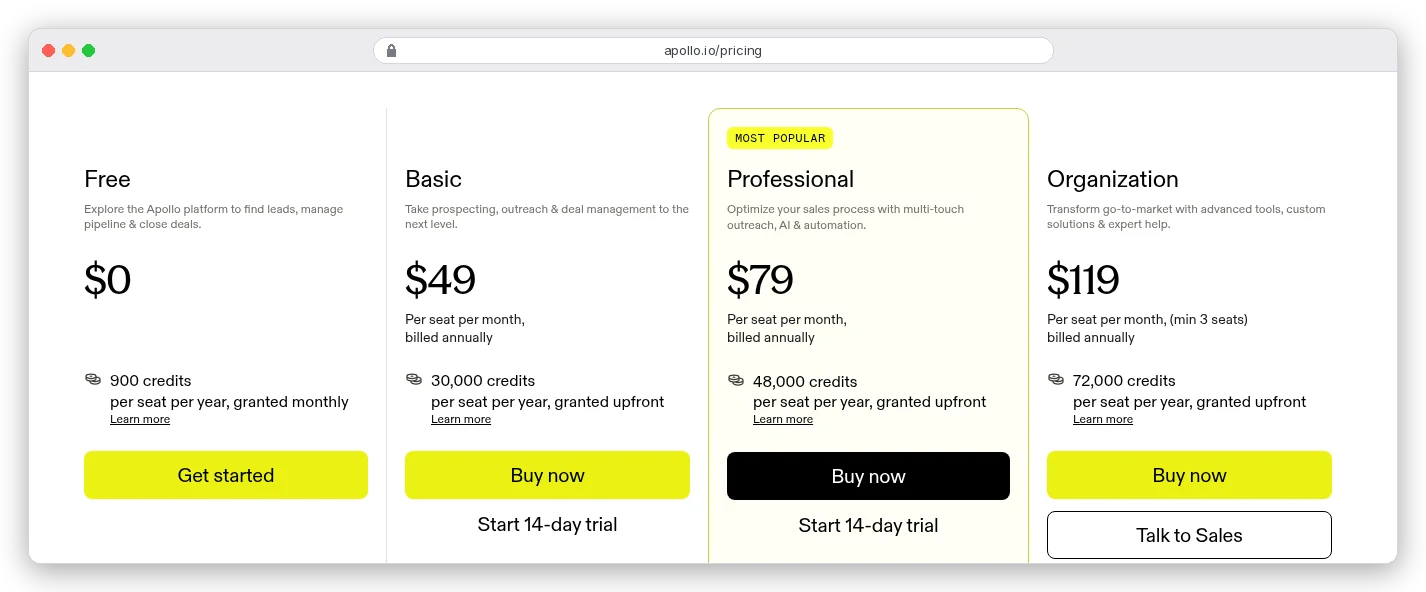
The toggle on the page says "SAVE 24%". That's true for Basic ($49 against $65). Professional saves 20% ($79 against $99), so the badge flatters the plan most teams actually buy.
Organization is a different kind of purchase. Switch the page to monthly and the card shows $149 with "Annual Only" under it. So the real entry price is three seats paid a year ahead: $4,284.
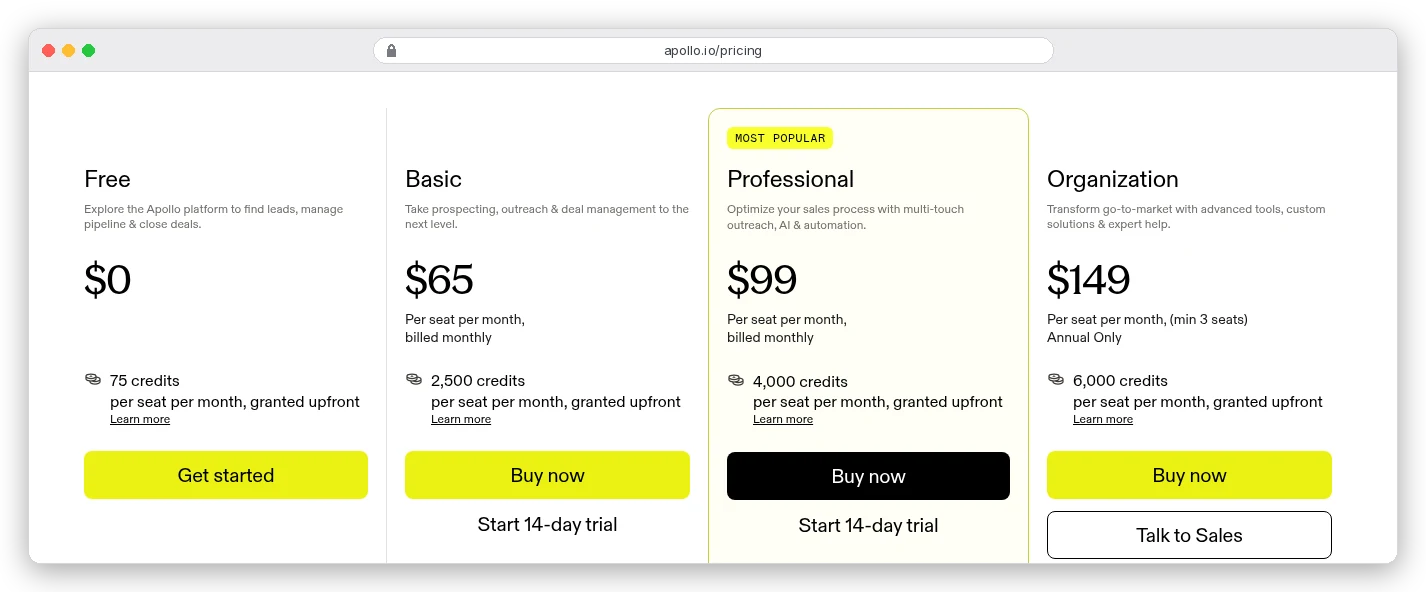
One more rule from the FAQ: every seat on an account sits on the same plan. If one rep needs Professional, the whole team pays for Professional.
What one Apollo credit actually buys
Apollo's credits are a single currency for data and a growing list of features. The pricing page lists the core rates:
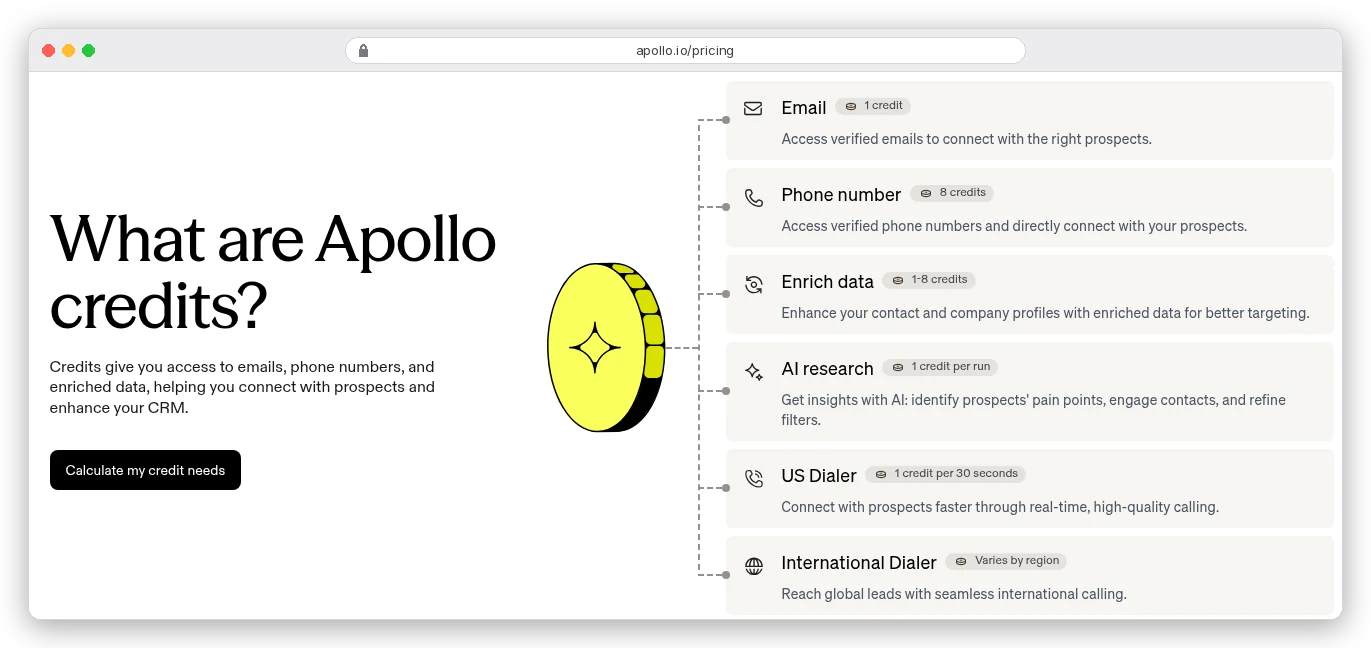
Emails are cheap. The credits page says Apollo never charges more than 1 credit per contact for email, and only charges for addresses it can verify.
Phone numbers are where the pool goes. At 8 credits each, Basic's 2,500 monthly credits buy 312 numbers and nothing else. Reveal 1,000 emails first and you have room for 187 numbers.
So what does a credit cost in dollars? It depends on the plan and the billing cycle:
| Plan and billing | Per credit | One email | One phone number (8 credits) |
|---|---|---|---|
| Basic, monthly | 2.6 cents | 2.6 cents | about 21 cents |
| Professional, monthly | 2.5 cents | 2.5 cents | about 20 cents |
| Basic, Professional or Organization, yearly | about 2 cents | about 2 cents | about 16 cents |
Notice the yearly rows are nearly identical. Professional doesn't buy cheaper credits than Basic; it buys more of them, plus features.
Waterfall enrichment makes the phone price a floor
Eight credits is what a number from Apollo's own database costs. Paid plans add waterfall enrichment. When Apollo doesn't have the number, it asks the third-party data sources your admin lined up, one after another.
Each source that returns data charges credits. The waterfall guide is blunt: a run "does not stop at the first result returned". It keeps going until a validated result turns up, and an optional validator charges separately after each source.
Apollo's API pricing docs put numbers on it. A phone waterfall typically uses 8 to 25 credits, and some setups hit 45 or more. Email waterfalls typically use 1 to 4.
At 25 credits, a phone number on monthly Basic costs about 65 cents. One yearly Basic seat's 30,000 credits then cover 1,200 numbers, not 3,750.
The fix is boring but it works. Check which sources your admin put in the lineup, and read the credit estimate Apollo shows before a run starts.
The limits that decide your plan (they aren't credits)
Most people pick an Apollo plan by credit count. The comparison table further down the pricing page has three rows that matter more.
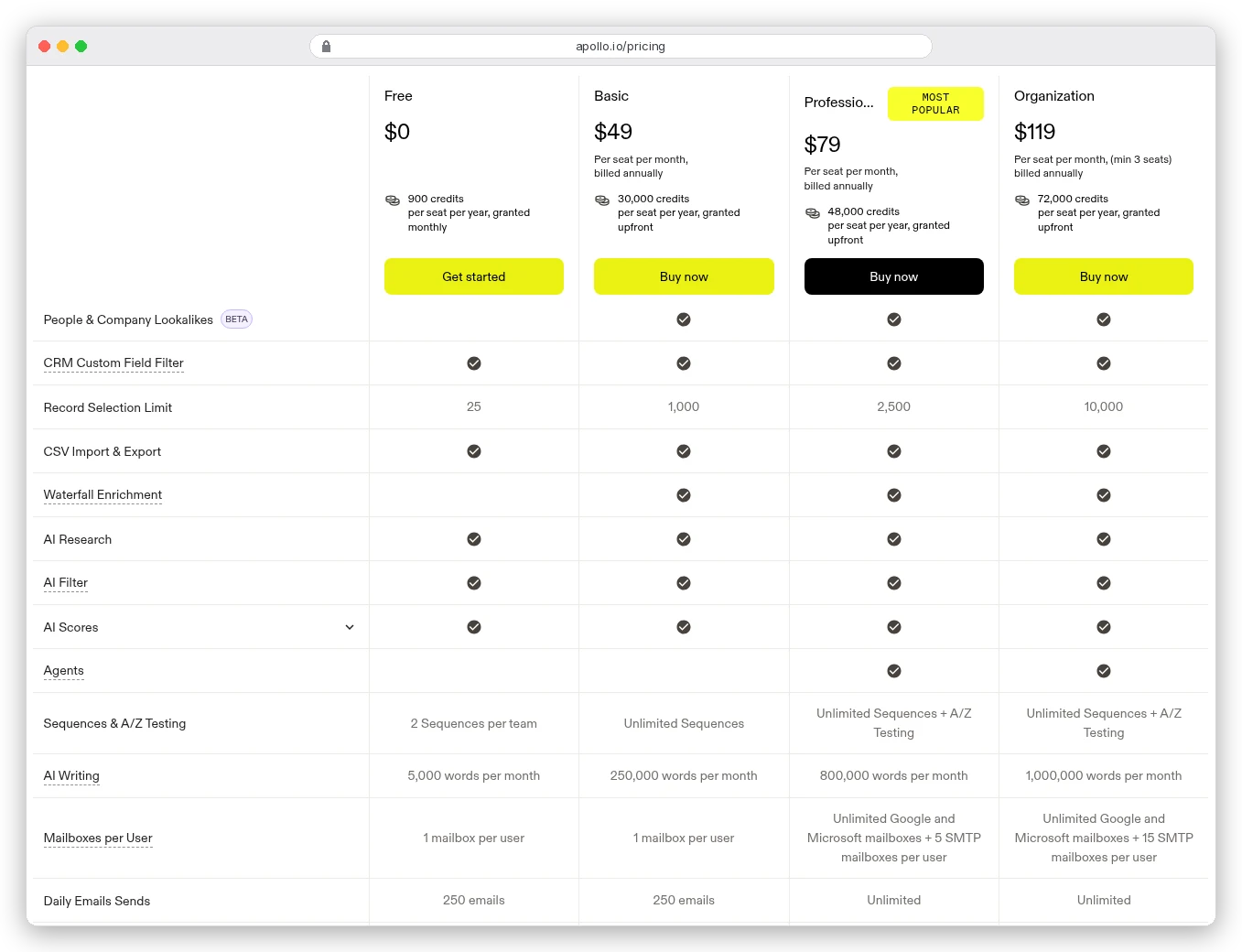
Daily sends are the loop from the intro. Free and Basic cap you at 250 emails a day; Professional and Organization show "Unlimited". Basic also allows only one connected mailbox per user, so you can't add inboxes to get around it.
Is 250 a day actually a problem? For most cold outreach, no. Apollo's sending limits guide says to start with 50 emails a day per mailbox. Our cold email deliverability guide explains why one mailbox shouldn't send much more than that anyway.
Where it bites is follow-ups. A four-step sequence to 60 new people a day is 240 sends once it's running, and the cap is nearly full.
The record selection limit is the second one. It caps how many records you can select from Apollo's database in one action. That's 25 on Free, 1,000 on Basic, 2,500 on Professional and 10,000 on Organization.
On Free, that means building a list 25 people at a time. On Basic it's an annoyance for big lists, not a blocker, because you can save in batches and bulk-export the saved records later.
The third is sequences. Free gets two per team. Every paid plan is unlimited, and A/Z testing starts at Professional.
Credits you spend without revealing anyone
Apollo now prices a lot of outbound infrastructure in the same credits. These come from its knowledge base, checked 5 November 2026:
- Email warmup: paid plans include one warmed mailbox per seat; each extra one costs 200 credits per 30 days, and warmup pauses itself if the balance runs short.
- Domains bought through Apollo: 1,500 credits per domain per year.
- Mailboxes bought through Apollo: 300 credits a month for Apollo SMTP, 800 for Google Workspace, 1,500 for Microsoft 365. Purchases are non-refundable.
- US dialer: 1 credit per 30 seconds, so an hour of calls is 120 credits.
- AI research: 1 credit per run. Our guide to personalising cold emails with AI shows how fast that adds up across a list.
- CSV exports: saved contacts export free, but net-new people picked straight from search cost 1 credit each if they have a verified email.
Here's how fast the setup costs add up. Say you're a founder on one monthly Professional seat. To protect your main domain, you buy a fresh domain and three Google Workspace mailboxes through Apollo, and warm all three.
The domain works out to about 125 credits a month, the mailboxes 2,400, and warming the two that aren't included another 400.
That's 2,925 of your 4,000 credits, 73%, before you've looked up a single prospect.
That doesn't make buying mailboxes through Apollo a bad idea. It means the credit count on the plan card isn't your prospecting budget if you run your sending setup from the same pool.
Monthly or yearly: what the discount costs you
Yearly billing is cheaper per credit, and it has one advantage people miss. Apollo releases the whole year's credits at the start of the cycle. A Basic seat gets 30,000 on day one instead of 2,500 a month.
That's useful if your prospecting comes in bursts. It's also easy to burn through by March.
The bigger catch is getting out. The pricing FAQ says mid-cycle downgrades on annual plans aren't permitted. Going from yearly to monthly means cancelling and waiting for the year to run out.
Downgrades that are allowed take effect immediately with no refund for unused time.
Running out mid-cycle has its own rules:
- Extra credits are bought with a slider under Manage Subscription and charged immediately.
- They're recurring: they renew every billing cycle until you set the slider back to zero.
- Unused credits expire at the end of each cycle, plan credits and add-on credits alike.
Put together, a one-off top-up for a big campaign quietly becomes a monthly charge unless someone remembers to remove it. Apollo's public pages don't list the per-credit price of add-ons; it's shown in the checkout, which we didn't open.
Admins can also set per-user credit caps, which is worth doing on day one for any team where one rep could drain the shared pool.
Add-ons are priced per team
Two add-ons sit on top of the paid plans, and both are billed per team rather than per seat. Apollo labels the prices introductory.
| Add-on | Billed yearly | Billed monthly | What it adds |
|---|---|---|---|
| Inbound Essentials | $119/mo | $149/mo | Website visitor identification, lead routing, forms and form enrichment |
| Inbound Max | $639/mo | $799/mo | Higher limits on the same inbound tools |
| Advanced Dialer | $119/mo | $149/mo | International, parallel and power dialing, local presence numbers |
If you only need US calling, you don't need the dialer add-on. The US dialer comes with Basic and up and bills in credits.
Is the free plan enough?
For trying Apollo, yes. For running outbound, not really.
Free gives 75 credits a month, 25-record selections, two sequences and Gmail as the only email connection. That's enough to learn the search filters and send a small test sequence. Our guide to finding and closing leads with Apollo walks through exactly that.
You might have noticed the pricing FAQ says even entry-level plans give "unlimited email addresses for your contacts". The credits table on the same page charges 1 credit per email. We'd budget by the credits table.
The 14-day trial on Basic or Professional is the better test if you're close to buying. It comes with 75 credits, so use it to check features, not to build a list.
Which Apollo plan should you pick?
If you're a solo founder sending one sequence from one mailbox and revealing mostly emails, Basic is enough. Take yearly billing only if you're sure you'll still be prospecting in twelve months.
If you need more than one sending mailbox, A/Z tests, or more than 250 sends a day, go to Professional. The credit difference isn't the reason; the mailbox and sending limits are.
If your list is mostly phone numbers, budget 8 credits a number at minimum and up to 25 with waterfall on. Then pick the plan whose pool covers that.
Organization makes sense for teams of three or more who need 10,000-record selections or the extra intent topics, and can commit a year ahead.
Still deciding whether Apollo should do your sending at all? Our Instantly vs Apollo comparison covers pairing Apollo's data with a separate sending tool. The business email finder guide covers other ways to get just the emails.