Firecrawl does one thing and does it cleanly: it turns the web into text a model can use. Give it a URL, a whole site or a search query, and it returns clean Markdown or structured JSON, handling JavaScript rendering, proxies and anti-bot measures along the way. For anyone building AI agents, RAG pipelines or LLM applications, that is often the entire problem.
This review covers what Firecrawl does well, where it falls short, what it really costs — including the pricing details that change the maths — and who should use it.
What Firecrawl is
Firecrawl is a web data API built for AI. Its core idea is that most AI applications do not want raw HTML — they want the readable content of a page, formatted for a model, without writing a scraper for every site.
It exposes that through a small set of endpoints, available through a REST API, Python and Node SDKs, a command-line tool and a hosted MCP server. You can even scrape a page without an API key to try it, with higher limits once you sign up.
Features
Scrape
The core endpoint. Give it one URL and get back Markdown, HTML, links, screenshots or structured JSON. Firecrawl handles the rendering and the defences; you get text. It costs 1 credit per page.
Crawl and Map
Crawl follows links across a whole site and returns the content of every page — the typical way to ingest documentation or a knowledge base into a vector store. Map discovers every URL on a site without fetching the content, which is useful for planning a crawl or choosing which pages to scrape. Both cost 1 credit per page.
Search
One of Firecrawl's most useful features for agents. It searches the web and returns the full page content of the results in a single call, rather than a list of links you then have to scrape one by one. It costs 2 credits per 10 results.
Interact
Scrape a page, then keep working with it: click buttons, fill in forms, search within a site and pull out dynamic content. You can describe what you want in plain English — "search for this product and tell me the price" — or write code for precise control. It costs 2 credits per browser minute.
Structured extraction
Request the JSON format with a schema or prompt and Firecrawl returns specific fields instead of a page of text. It is powerful and convenient, but it is also where costs jump: the JSON, Question and Highlight formats add 4 credits per page, making an extracted page five times the cost of a Markdown scrape.
Agent, Monitor and Parse
- Agent (in preview) gathers web data autonomously from a goal rather than a URL. It includes five free runs a day, with dynamic pricing beyond that.
- Monitor checks pages over time, at 1 credit per page per check, or 7 credits per page per check with its deterministic extraction engine.
- Parse turns local PDFs, Word documents, spreadsheets and HTML files into Markdown or JSON through the same API.
Built for coding agents
Firecrawl leans hard into agent workflows. Its hosted MCP server connects to Claude Code, Cursor, Codex and other clients with a browser sign-in, and its CLI installs Firecrawl skills into every coding agent it detects. If your workflow already runs through an AI coding assistant, it slots in with almost no setup.
Pricing
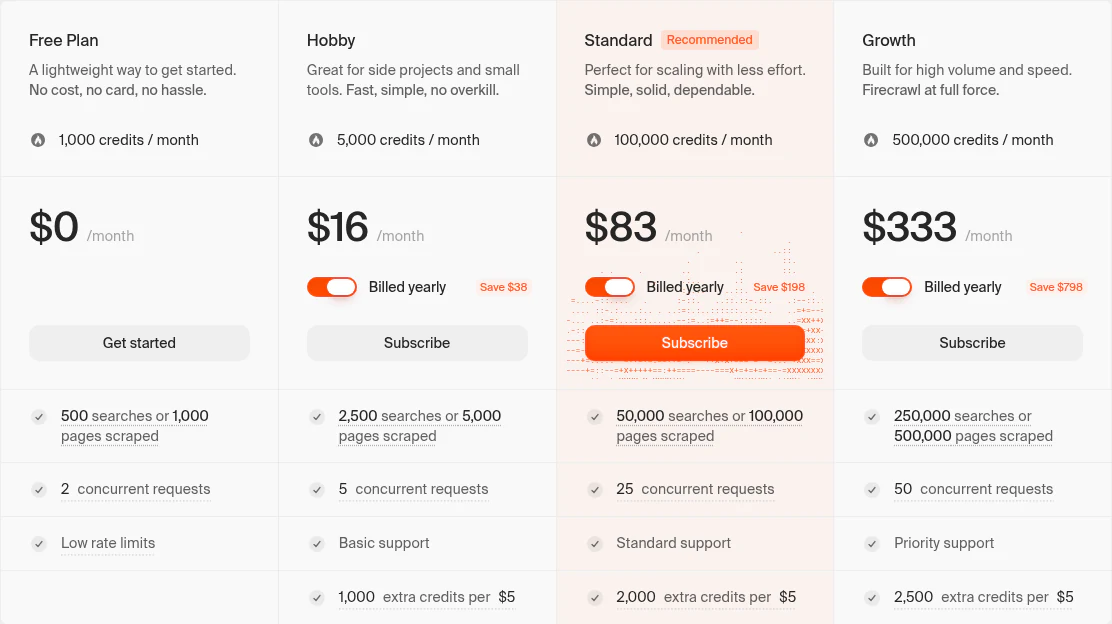
| Plan | Annual (per month) | Credits / month | Pages per $ (Markdown) | Concurrent requests |
|---|---|---|---|---|
| Free | $0 | 1,000 | — | 2 |
| Hobby | $16 ($19 monthly) | 5,000 | 313 | 5 |
| Standard | $83 | 100,000 | 1,205 | 25 |
| Growth | $333 | 500,000 | 1,502 | 50 |
| Scale | $599 | 1,000,000 | 1,669 | 100 |
| Enterprise | Custom | Custom | — | Custom |
The free plan's 1,000 credits refresh every month with no card required — about 1,000 pages or 500 searches. Annual billing saves 16.7% on Hobby, Standard and Growth, and 20% on Scale.
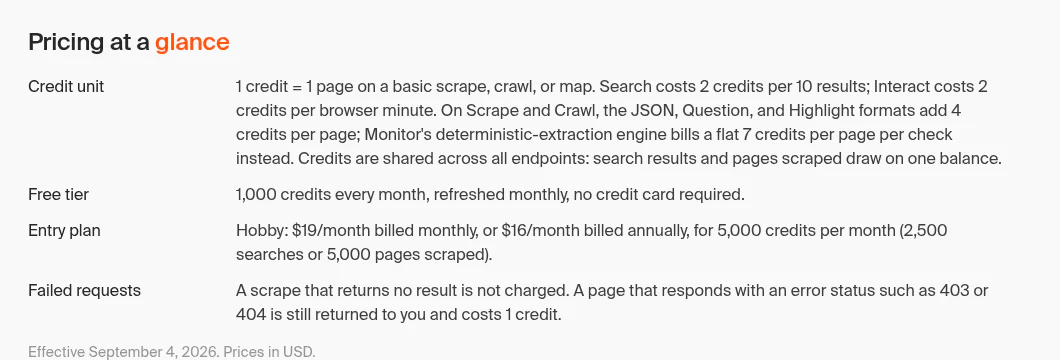
Credit costs at a glance
| Action | Credits |
|---|---|
| Scrape, Crawl, Map | 1 per page |
| Search | 2 per 10 results |
| Interact | 2 per browser minute |
| JSON, Question or Highlight formats | +4 per page |
| Monitor | 1 per page per check (7 with deterministic extraction) |
| Agent (preview) | 5 free runs daily, then dynamic |
These rates are the same on every plan. What changes between plans is how many credits you get, how much concurrency you have, and how cheaply you can buy more.
Three pricing details that change the maths
1. Hobby is the expensive way to buy pages
Hobby works out to about $3.20 per 1,000 pages. Standard is about $0.83 — roughly four times cheaper per page. Hobby also has the worst top-up rate, with $5 buying 1,000 extra credits against 2,000 on Standard and 5,000 on Scale.
So if you regularly exceed Hobby's 5,000 credits, you are paying premium rates twice over. The break-even is roughly 18,000 pages a month on annual billing, or about 21,000 on monthly: past that, Standard is cheaper than Hobby plus top-ups, even if you never use most of its credits.
2. Structured extraction multiplies everything by five
Because JSON extraction adds 4 credits to the 1-credit page, extracting fields from 100,000 pages consumes 500,000 credits — the difference between Standard at $83 a month and Growth at $333. Before you default to JSON output, consider whether you can take Markdown and run extraction with your own model. At volume, that is frequently cheaper.
3. Credits mostly expire
Plan credits do not roll over on Hobby, Standard or Growth. Scale carries unused credits for one month. Pay-as-you-go credits you buy stay on your account until used, which makes them a reasonable buffer — but they expire if you cancel your subscription.
On failed requests, Firecrawl does not charge for a scrape that returns nothing, but it does charge 1 credit for a page that responds with an error status such as a 403 or 404. On a crawl with many dead links, those add up.
Rate limits and concurrency
Limits scale steeply with plan, and on the lower tiers they are the constraint you will hit first:
| Plan | Scrape, Map, Search per minute | Crawl, Agent per minute |
|---|---|---|
| Free | 10 | 2 |
| Hobby | 100 | 20 |
| Standard | 500 | 100 |
| Growth | 5,000 | 1,000 |
| Scale | 10,000 | 2,000 |
The free plan's 10 requests a minute and 2 concurrent browsers are fine for testing and far too low for production. If you are building something users depend on, plan for at least Hobby, and more likely Standard.
Open source and self-hosting
Firecrawl's core engine is open source. You can self-host the Scrape, Crawl, Map and Search APIs with Docker Compose, which gives you source access and full control of where data goes.
The limits are real, though. Agent, Browser, Interact, the dashboard, enhanced proxy paths and enterprise controls are Cloud-only, and LLM-backed extraction requires you to connect your own OpenAI-compatible provider or a local model. You also own security, persistence, monitoring and upgrades. Firecrawl itself recommends starting on Cloud unless infrastructure control is genuinely worth the operational work — which is good, honest advice.
Security and compliance
Firecrawl lists SOC 2 Type II, regular penetration testing, multi-factor authentication, signed webhooks and PII redaction on every plan, including free. Standard and above include a countersigned Data Processing Agreement. Zero data retention, SSO, SCIM, API key restrictions and static egress IPs are Enterprise-only.
Where Firecrawl falls short
- No prebuilt site scrapers. For structured data from specific platforms such as Google Maps or Instagram, Apify's library of ready-made Actors gets you there faster.
- Static sites cost more than they need to. Firecrawl charges the same per page whether or not a site needs a browser, so on simple sites a plain HTTP crawler can be far cheaper.
- Extraction is expensive. The fivefold cost of JSON output makes built-in extraction a premium feature at volume.
- Low-tier limits are tight. Hobby's per-page price and rate limits make it a stepping stone rather than a production plan.
- Self-hosting is partial. The open-source version lacks several of the features that make the Cloud product attractive.
Firecrawl vs the alternatives
The most common comparison is with Apify. In short: Firecrawl is the better fit for turning arbitrary pages into LLM-ready content with predictable pricing; Apify is better for structured data from specific platforms and for cheap crawling of static sites. We compare them in detail in Apify vs Firecrawl.
Who should use Firecrawl
Use it if you are building AI agents, RAG pipelines, research tools or LLM applications that need web content; you want one clean API rather than a scraping platform; your targets are modern, JavaScript-heavy sites; or you work through an AI coding assistant and want web access with almost no setup.
Look elsewhere if you need structured records from specific well-known platforms, your targets are mostly static sites at high volume, or you need a fully featured self-hosted deployment.
Verdict
Firecrawl is the most straightforward way to give an AI application access to the web. The API is simple, the output is genuinely model-ready, search returning full page content is exactly what agents need, and the flat per-page price makes costs easy to predict on the kind of script-heavy sites that make other tools unpredictable.
Its weaknesses are mostly about pricing shape rather than capability. Hobby is an expensive way to buy pages, structured extraction costs five times as much as Markdown, and on static sites you pay for rendering you did not need. Size your plan honestly — on Standard if you are past a hobby project, and on five credits per page if you extract — and it is excellent value for what it does.
The free plan's 1,000 monthly credits are enough to test it properly on your real targets before committing.
A note on these figures
Firecrawl changes its pricing and features regularly; the credit rates above took effect on 4 September 2026. Everything here reflects Firecrawl's live pricing page and documentation as checked on 19 September 2026. Pages-per-dollar figures assume a basic 1-credit scrape on annual billing. Confirm current pricing before you commit.