You pay $29 for HeyGen Creator, see "600 credits", and assume that's roughly ten hours of talking head.
Then you make six videos with the newest avatar model and your balance is gone. Nothing went wrong, and nothing was hidden from you exactly, but it wasn't on the pricing page either.
HeyGen's credits buy very different amounts of video depending on one dropdown, and that dropdown decides whether $29 gets you 150 minutes a month or 12. Before you switch tools, work out which one you were paying for.
Every price and limit here was checked against each vendor's own pricing page and help docs on 27 September 2026.
The short version
| If you want | Pick | Why |
|---|---|---|
| Corporate training and SCORM | Synthesia | Published minutes, up to 240+ stock avatars, LMS export |
| Expressive performance from one photo | Hedra | Character-3 handles singing and emotion, from $20 |
| Cheap minutes through an API | D-ID | 100 minutes for $108, same balance for API and studio |
| Interactive courses and quizzes | Colossyan | Branching video and SCORM on a $59 plan |
| Paid ads and UGC-style creative | Creatify | 1,500 actors, ad templates, competitor ad tracker |
| A personal clone that posts daily | Argil | $25 for 1,000 credits aimed at short-form |
Those are the picks. The reasons are worth reading, because three of these price in credits, two in minutes, and one in videos, and that's where the comparisons you'll find elsewhere fall apart.
What HeyGen actually charges you
Start where everyone starts, on the pricing page.
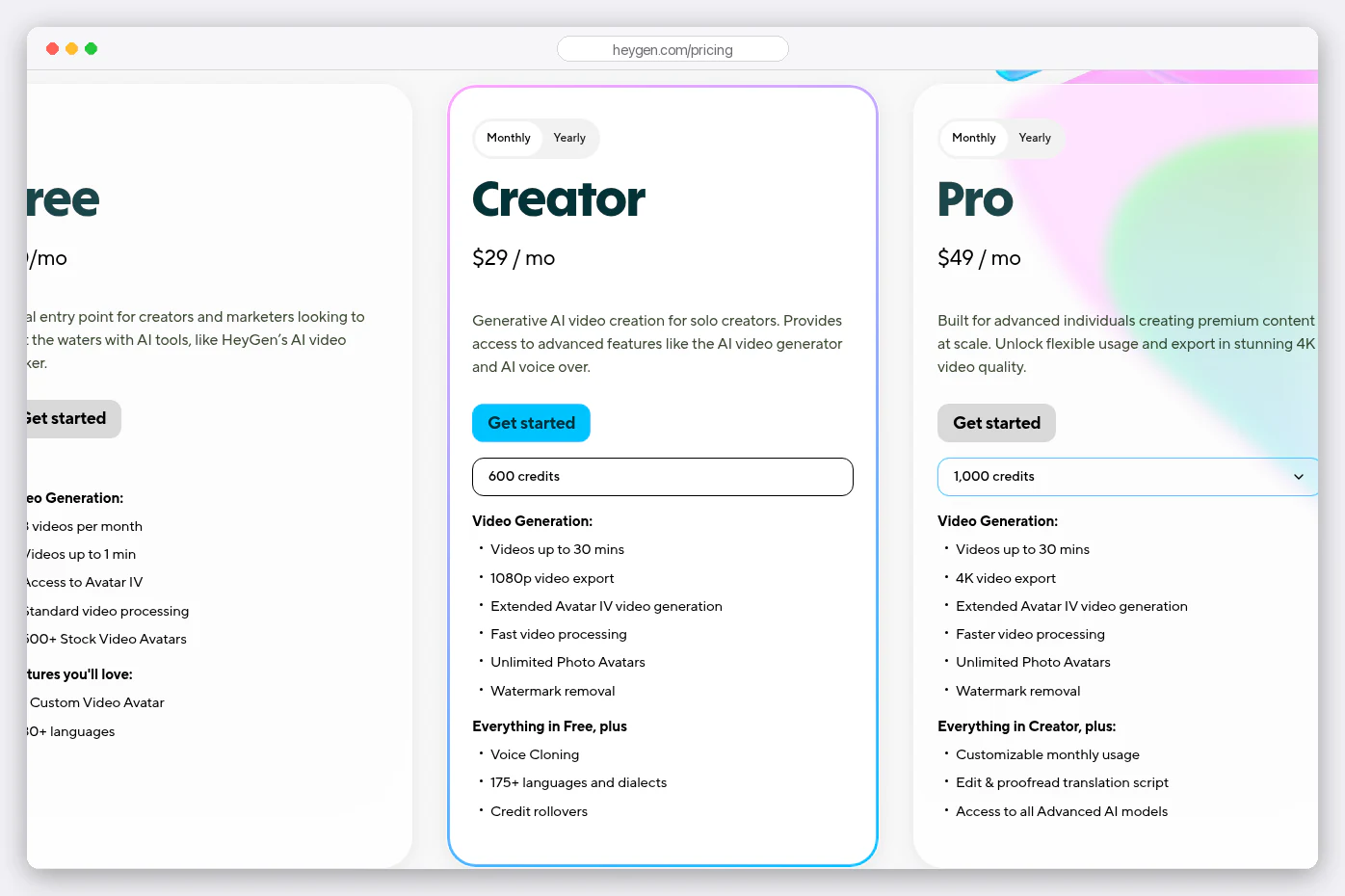
Free gives you three videos a month, capped at a minute each. Creator is $29 a month ($24 billed yearly) for 600 credits, videos up to 30 minutes and 1080p export. Pro is $49 for 1,000 credits and 4K, and Business is $149 for 1,500.
So what's a credit? The pricing page doesn't say. The help centre does, and this is the part that changes everything:
| What you generate | Credits per minute | Minutes from Creator's 600 |
|---|---|---|
| Avatar III, video look | 4 | 150 |
| Avatar III, photo look | 7 | 86 |
| Avatar IV, photo look | 16 | 37 |
| Avatar IV, video look | 31 | 19 |
| Avatar V, either look | 48 | 12.5 |
| Video translation, with lip sync | 6 | 100 |
Read that top to bottom. The same $29 buys 150 minutes of video or 12.5, and the only difference is which avatar model you picked.
On Avatar V that works out at $2.32 a finished minute. On Avatar III it's 19 cents, which is a twelvefold gap inside one subscription.
You're probably thinking the older models must look rough. They don't look bad, and for a plain talking head at 1080p most viewers won't tell. But you'll feel the difference on close-ups and expressive delivery, which is exactly when people reach for the newest model and stop watching the meter.
That's the real question behind "what's a good HeyGen alternative": are you paying for minutes, or for the top model?
Synthesia, if the video has to survive a compliance review
Synthesia is the one big companies already bought. It sells the same thing HeyGen does, minus the consumer-ish edges and plus the paperwork an L&D team needs.
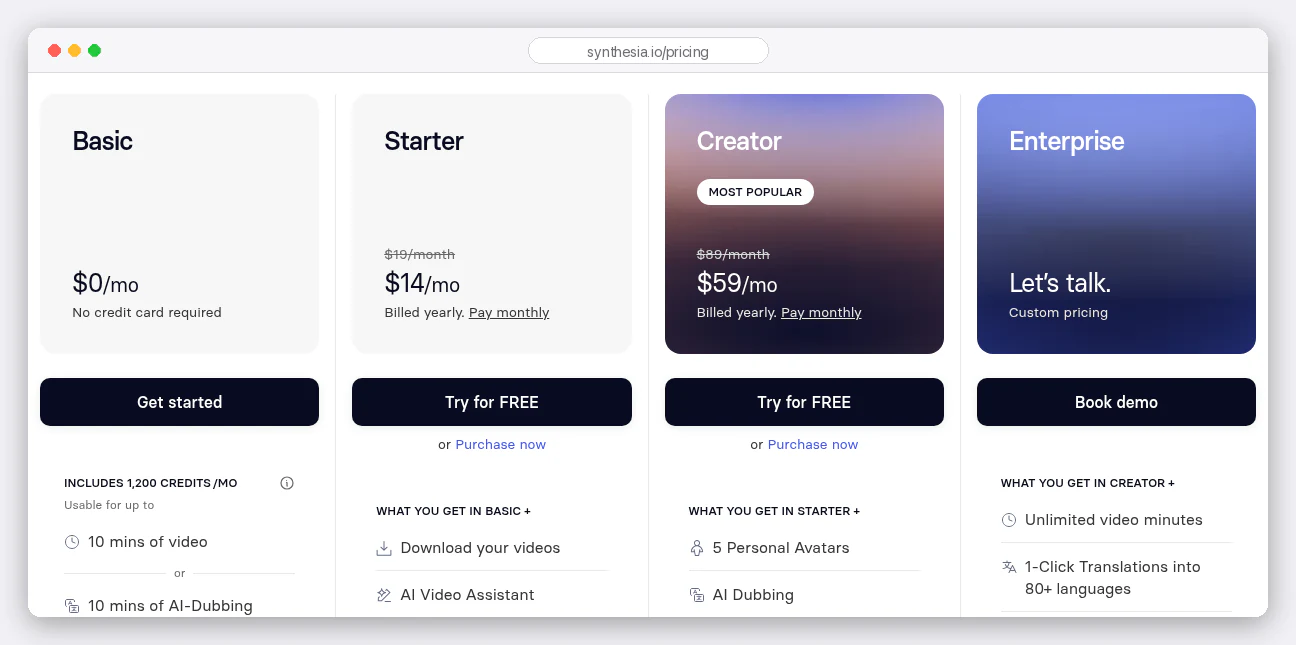
Prices dropped recently: Starter is $14 a month billed yearly ($19 monthly), Creator is $59 ($89 monthly), and the free plan carries 1,200 credits a month.
Synthesia's credits come with a translation: 1,200 credits is "10 mins of video, or 10 mins of AI-Dubbing". Starter gets 14,500 credits a year, which is 120 minutes of video. Creator gets 44,000, or 360 minutes.
That makes Creator about $1.97 a finished minute, and the rate doesn't move when you pick a better-looking avatar. Predictable, if not cheap.
The catch is the shape of the plans. One editor on Starter, one on Creator, with guests rather than seats, so a team of three needs Enterprise. And the highest-quality custom avatar is a $1,000-a-year add-on on top of the plan.
Hedra, when the face has to act
Hedra came at this from the other end. Instead of a studio with stock presenters, it animates one photo you give it, and it aims at performance: singing, emotion and the awkward human beats.
Pricing changed this month, so check it against anything you read in an older roundup. Basic is now $20 a month for 2,000 credits, Pro $50 for 7,200, Ultra $100 for 18,000, and Teams $75 for 14,400.
Here's the honest gap: Hedra doesn't publish how many credits a second of video costs, and its docs deliberately point you at the live model selector instead. So you can't work out your cost per minute before you sign up. Generate one 30-second clip and watch the balance, which takes two minutes and settles it.
We went deeper on that in our Hedra pricing guide, including the test.
D-ID, the cheapest published minutes
D-ID sells minutes, plainly, and one balance covers both the studio and the API. That combination is rare in this group.
Lite is $4.70 a month for 10 minutes. Pro is $16 for 15 minutes, which adds commercial rights, three personal avatars and one voice clone. Advanced is $108 for 100 minutes, and there's a 14-day trial with 3 minutes.
Advanced works out at $1.08 a minute, and Pro at $1.07 for a much smaller allowance. Those are the cheapest published rates here, outside HeyGen's own older models.
Two details the pricing page buries. Every video rounds up to the nearest 15 seconds, so a 1:10 clip bills 1:15. And unused minutes never roll over.
One nice touch for anyone already paying for voice: from Pro up, you can import third-party voices, ElevenLabs included, instead of using D-ID's own.
Colossyan, for training that asks questions back
Colossyan looks like Synthesia until you notice what it's built around: interactive video. Quizzes, branching scenarios, and SCORM files an LMS will accept.
The free Starter plan is unusually generous, at 20 minutes a month on its standard model plus 15 custom avatars. Professional is $59 a month billed yearly for 30 minutes on NEO and 10 on NEO2, watermark removal and 5 SCORM exports a month.
Editors cost $30 a month each, capped at three. An annual plan hands you the whole year's minutes up front, which suits bursty course production.
The costs to watch sit outside the plan. A studio-filmed custom avatar is $1,000 a year, and extra NEO2 minutes come in packs of 600 for $1,500 a year. At that point you're negotiating, not subscribing.
Creatify, if the video is an ad
Creatify isn't trying to be a video studio. It's trying to make ads that perform, and it prices like an ad tool.
Starter is $39 a month for 100 credits and 300 AI actors, with videos up to two minutes. Pro is $99 for 300 credits, 1,500 actors, three custom avatars, videos up to ten minutes and five generations in parallel. The free plan gives 10 credits, enough for about two video ads, watermarked.
What you're really buying at $99 is the layer around the video. That means 500+ ad templates, a competitor ad tracker across 10M+ Meta ads, and an agent that pushes creative to Meta, TikTok and AppLovin.
So if you only need a presenter reading a script, this is the wrong tool at the wrong price.
Argil, for a clone that posts every day
Argil is the smallest bet here, aimed at creators who want their own face in short-form video without filming daily.
Pro is $25 a month for 1,000 credits and Business is $50 for 2,000, with two months free if you pay yearly.
Like Hedra and Creatify, it prices in credits without publishing a minutes conversion, so budget from a test run rather than the pricing page.
What a finished minute costs
Here's every rate we could work out from published numbers, which is the comparison the vendor pages avoid.
| Plan | Price | Published minutes | Cost per minute |
|---|---|---|---|
| HeyGen Creator, Avatar III video look | $29/mo | 150 | $0.19 |
| D-ID Lite | $4.70/mo | 10 | $0.47 |
| D-ID Pro | $16/mo | 15 | $1.07 |
| D-ID Advanced | $108/mo | 100 | $1.08 |
| Synthesia Starter (yearly) | $14/mo | 10 a month | $1.40 |
| Synthesia Creator (yearly) | $59/mo | 30 a month | $1.97 |
| Colossyan Professional (yearly) | $59/mo | 30 on NEO | $1.97 |
| HeyGen Creator, Avatar V | $29/mo | 12.5 | $2.32 |
Hedra, Creatify and Argil aren't in the table because none of them publishes a minutes figure. And D-ID's Lite row comes with a catch: that plan is licensed for personal use only, so commercial work starts at Pro.
Now look at the two ends of that table. The cheapest row and the most expensive row are the same HeyGen plan.
How we compared these
We read each vendor's pricing page and help docs on 27 September 2026, and took the screenshots above from those pages. The per-minute arithmetic is ours, done from their published numbers.
What we didn't do: render the same script on all seven and score the output. Avatar quality moves monthly, and a ranking from a September test would mislead you by November. Every plan here has a free tier or a trial, so the honest test is your own script on your own face.
So which one should you actually pick?
Stay on HeyGen if its library and translation are why you're there, and switch avatar models rather than tools. Moving from Avatar V to Avatar III photo look turns 12.5 minutes into 86 for the same $29.
Switch to Synthesia if a compliance team will ever watch the video, or to Colossyan if it needs a quiz at the end. Go to D-ID for the most published minutes per dollar, or for one balance across studio and API.
Pick Hedra when the performance matters more than the platform, Creatify when the video is an ad, and Argil when the point is posting daily as yourself.
Still unsure? Write one 60-second script. Run it on your current plan and on one alternative's free tier, and compare what each cost you in credits, not what the pricing page promised.
[[cta:heygen|Check what your plan buys on each avatar model|See HeyGen plans]]For the voice half of this problem, see our guide to the best AI audio generation tools.