Your audiobook narrator quits at chapter nine.
Not the narrator, the credits. ElevenLabs Creator is $22 a month for 121,000 credits, and a credit is a character, so you get roughly two hours of finished speech before the meter stops.
Two hours. That's the part nobody mentions when they recommend it, and it's why people start shopping around at exactly the point their project gets serious.
So what does that same hour cost elsewhere? Under $2 at three of the vendors below, and the catch is what you give up to get there.
Every price here was checked against each vendor's own pricing page or API docs on 27 September 2026.
The short version
| If you want | Pick | Starting price |
|---|---|---|
| The cheapest hours of narration | Fish Audio | $5.50/mo, or $15 API per ~12 hours |
| Real-time voice agents | Cartesia | $5/mo, free tier included |
| A pay-per-character API with no plan | MiniMax | $60 per million characters |
| Control over emotion and delivery | Hume | $3/mo, $0.15 per 1,000 extra characters |
| Speech inside an existing dev stack | Deepgram | $0.030 per 1,000 characters |
Five picks, five different reasons. None of them replaces ElevenLabs on every axis, and one section below is entirely about what breaks when you leave.
What ElevenLabs actually costs per hour
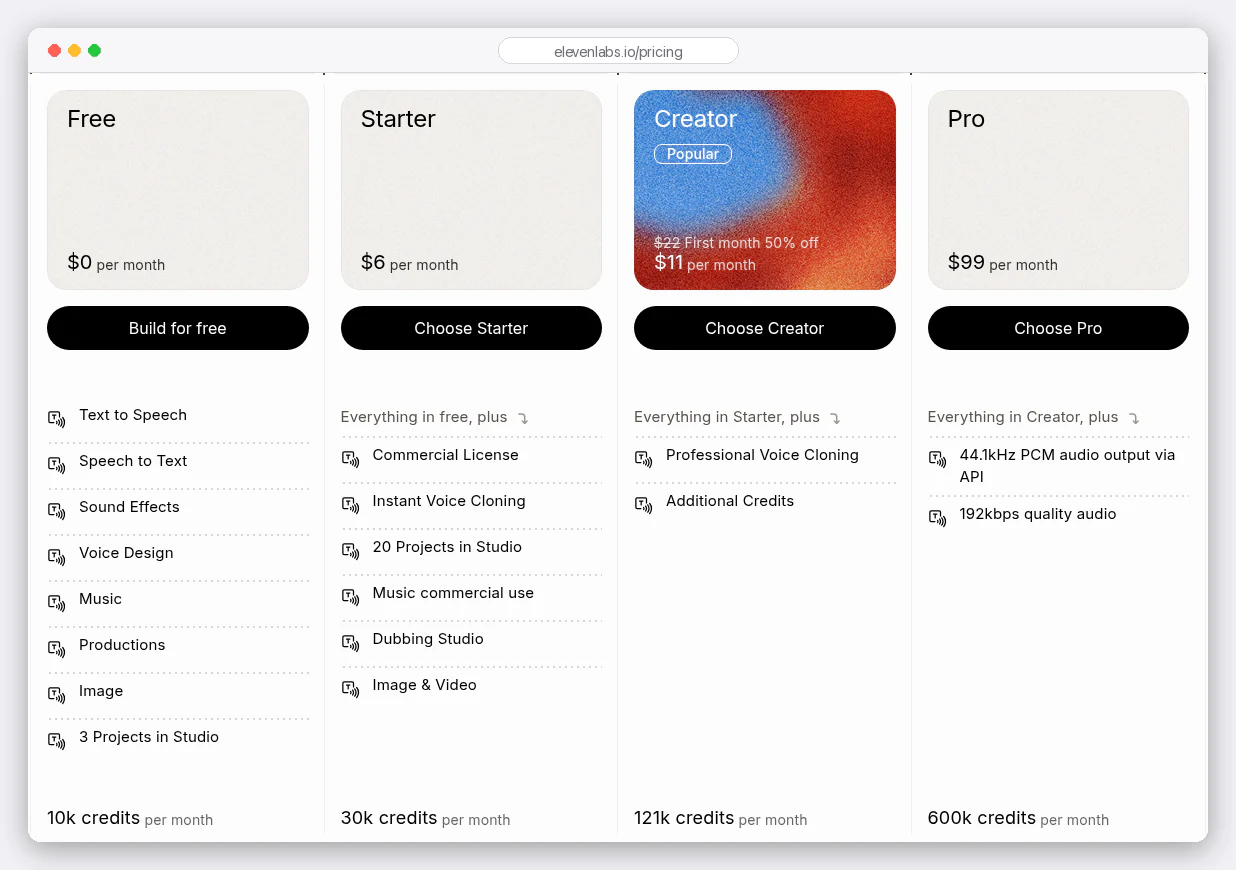
Free gives 10,000 credits a month. Starter is $6 for 30,000, Creator $22 for 121,000 ($11 for the first month), Pro $99 for 600,000, and Business $990 for six million with ten seats.
Credits are characters, and roughly 1,000 characters is a minute of speech. That's Hume's published ratio, and Fish Audio's page implies about 1,250, so treat every per-hour figure here as a close estimate rather than a quote.
Run it through and Creator is about $10.90 an hour of finished audio. Pro and Business both land near $9.90.
Now the same maths on everyone else:
| Plan or rate | Price | Speech included | Cost per hour |
|---|---|---|---|
| Deepgram Aura-1 | $0.015 / 1k chars | Pay as you go | $0.90 |
| Fish Audio API (s2.1-pro) | $15 / 1M bytes | ~12 hours, their figure | $1.25 |
| Fish Audio Pro | $37.50/mo | 1,620 minutes, their figure | $1.39 |
| Cartesia Startup | $49/mo | ~1,667 minutes, their figure | $1.76 |
| Deepgram Aura-2 | $0.030 / 1k chars | Pay as you go | $1.80 |
| MiniMax speech-2.8-turbo | $60 / 1M chars | Pay as you go | $3.60 |
| Hume Pro | $70/mo | 1,000,000 chars (~1,000 min) | $4.20 |
| MiniMax speech-2.8-hd | $100 / 1M chars | Pay as you go | $6.00 |
| ElevenLabs Pro | $99/mo | 600,000 credits | $9.90 |
| ElevenLabs Creator | $22/mo | 121,000 credits | $10.90 |
So ElevenLabs sits at roughly five to ten times the cost per hour of the cheapest options here.
That gap must be quality, surely? Partly. It's also the voice library, the dubbing tools and the Studio, plus the fact that their models are what everyone else gets compared against.
Whether that's worth ten times per hour depends on what happens after the audio is made. Which is what the rest of this post is about.
Fish Audio, the cheapest good narration
Fish Audio does the thing ElevenLabs does, at a fraction of the price, and it tells you the minutes.
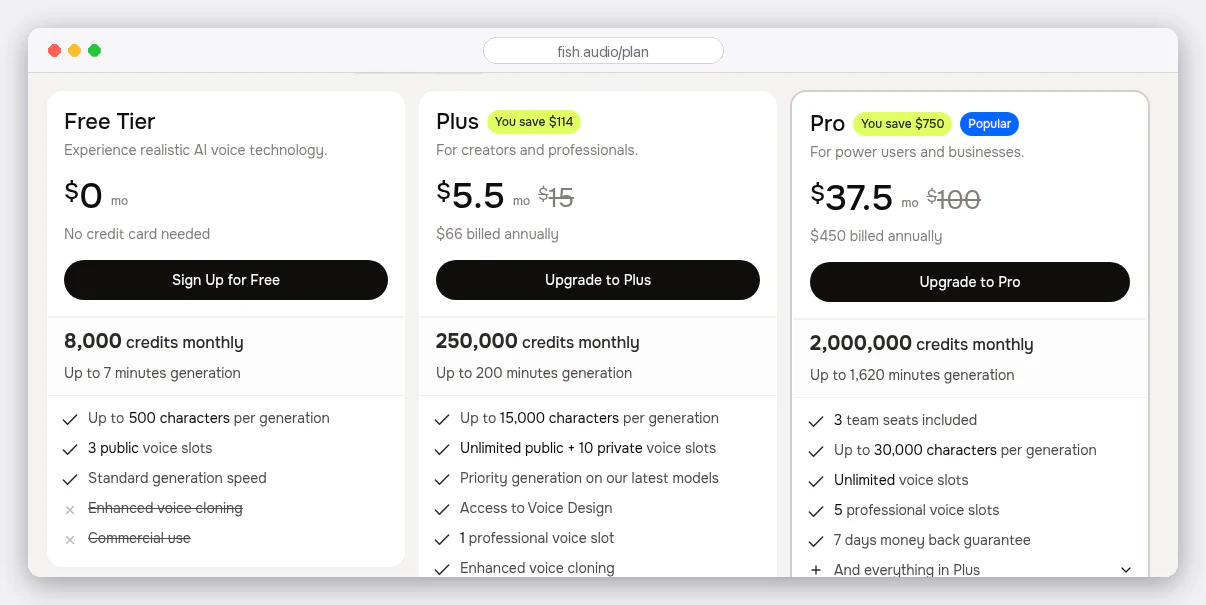
The free tier is 8,000 credits a month, about seven minutes. No commercial use. Plus costs $5.50 a month for 250,000 credits, which Fish puts at 200 minutes, and Pro is $37.50 for 1,620 minutes across three team seats.
Watch those prices, though. They're a limited-time 50% off annual promotion, with a countdown on the page. The regular rates are $15 and $100, which moves Pro from $1.39 an hour to $3.70.
The API is the more interesting number: $15 per million UTF-8 bytes, which Fish Audio describes as about 180,000 English words, or roughly 12 hours of speech. There's also a free model, s2.1-pro-free, at $0.00.
The honest catch is language coverage. Fish is strongest in English and a handful of major languages, so if your work is multilingual, test your languages before you commit.
Cartesia, built for things that talk back
Cartesia isn't aimed at narration at all. It's aimed at voice agents, where the delay between someone finishing a sentence and your app answering decides whether the call feels human.
The free tier is 20,000 credits a month, about 27 minutes. Pro is $5 for roughly 133 minutes, Startup $49 for about 1,667, and Scale $299 for about 10,667.
Cartesia publishes those minutes per plan, which makes budgeting simple: Startup works out at $1.76 an hour.
What you're really buying is the agent stack around it. Calls cost $0.06 a minute, a Cartesia phone number $0.014 a minute, and concurrency climbs from 2 requests on free to 15 on Scale.
If you're making an audiobook, that concurrency ceiling will annoy you. If you're making a phone agent, it's the whole point.
MiniMax, per character and nothing else
No plan, no credits, no seats. MiniMax bills per character and publishes the rate in its API docs.
speech-2.8-turbo costs $60 per million characters and speech-2.8-hd costs $100. Designing a new voice is $3, cloning one is $1.50, and each is charged when you first use the voice rather than when you make it.
Turbo works out at about $3.60 an hour, HD at $6.00. That's more than Fish Audio and much less than ElevenLabs, with no monthly commitment to forget about.
The trade-off is everything around the API. There's no studio to hand a freelancer, and the ecosystem is thinner than the Western vendors if you need integrations.
Hume, when the delivery matters more than the price
Hume sells control of how a line is said. Its Octave models take instructions about emotion and delivery, which matters when a flat read ruins the work.
Plans start free with 10,000 characters a month, which Hume puts at about ten minutes. Starter is $3 for 30,000, Creator $14 for 140,000, Pro $70 for a million (about 1,000 minutes), Scale $200 for 3.3 million and Business $500 for ten million.
Extra characters cost $0.15 per thousand at the bottom and $0.05 at the top, which is the clearest overage pricing in this group.
Pro lands at about $4.20 an hour. That's four times Fish Audio, and still less than half of ElevenLabs Creator.
The limit to watch is throughput. Requests per minute run from 15 on the small plans to 225 on Business, so a batch job needs planning.
Deepgram, if you already ship voice features
Deepgram is a developer platform first, and its text to speech is priced like infrastructure.
Aura-1 costs $0.0150 per 1,000 characters and Aura-2 $0.030, dropping to $0.027 on the Growth plan. New accounts get $200 of free credit, which is a lot of testing.
At those rates you're paying $0.90 to $1.80 an hour, the cheapest published numbers in this post.
What you won't find is a voice marketplace or a studio interface. This is an API for a product team that already knows what it wants the voice to say.
What you give up when you leave
Price is the easy part of this decision. So what actually sends people back?
- The voice library. ElevenLabs has thousands of community voices, and no one else here comes close on selection.
- Professional voice cloning, which needs longer consented recordings and arrives on Creator and above.
- Dubbing and Studio, where a long project gets managed as a project rather than a pile of API calls.
- Language coverage, which is still the deepest of this group.
- Being the default, so when a client says "make it sound like that demo", the demo was probably ElevenLabs.
There's also a cheaper middle path people miss. ElevenLabs' own Business plan advertises low-latency TTS "as low as 5c/minute", which works out at $3 an hour. Heavy API use can cost far less than the creator plans suggest.
[[cta:elevenlabs|Generate the same line before you switch|Hear the benchmark]]How we compared these
We read each vendor's pricing page or API docs on 27 September 2026 and took the screenshots above from those pages. The per-hour figures are our arithmetic on their published numbers.
Two assumptions worth stating. We treated 1,000 characters as a minute of speech, using Hume's own published ratio, and where a vendor published its own minutes, we used theirs instead. Your mileage moves with punctuation, language and speaking rate.
We didn't run a listening test. Model quality changes monthly, every vendor here has a free tier, and your own script in your own language settles it faster than our opinion would.
So which one should you pick?
For narration at volume, go to Fish Audio and check your languages on the free tier first. For an agent that answers the phone, Cartesia, because latency and concurrency are the constraints that matter.
For an API you can bolt on and forget, MiniMax if you want per-character simplicity, or Deepgram if you're already in that stack and want the lowest rate.
Choose Hume when the read matters more than the bill. Stay on ElevenLabs when you need the voice library, the dubbing tools, or a language nobody else covers properly.
Remember the audiobook that stalled at chapter nine? On Fish Audio Pro, the same money buys about 27 hours instead of two. That's the whole argument, as long as the voice holds up in your language.
Our ElevenLabs vs Fish Audio comparison goes deeper on that specific switch, and the best AI audio tools guide covers music and sound effects too.