You generated a clean product shot. The client wants it on the store page this week. Someone on Slack asks: "Are we allowed to use AI images commercially?"
Most tools say "yes, on a paid plan." That answer mixes three different things: vendor permission, ownership language in the contract, and whether copyright law lets you enforce the image against copycats.
We'll separate those, then cover ImagineArt, OpenArt, major models, and U.S. Copyright Office publications.
Not legal advice. Terms differ by country. Read the current terms for your tool and plan, and talk to a lawyer for high-stakes work. Sources checked 5 November 2026. Docs-only; no generations and no legal opinion for this post.
What does "commercial use" of AI images mean?
In plain English: using the image in anything that sells, promotes or delivers work for money. Ads, product pages, paid social, client decks, merch, stock uploads, a logo on a paid app. Personal mood boards and unpaid practice usually fall outside that bucket.
Vendors define the line in their own terms. Midjourney's docs talk about company revenue thresholds. OpenArt ties commercial rights to Plus and above. ImagineArt points paid subscribers at commercial projects and keeps free or trial use on the personal side unless they say otherwise.
Match the intended use to the plan you were on when you generated the file.
One trap: "I posted it on Instagram for my brand" still looks commercial if the account sells something. Write down the use before you argue with a FAQ.
Licence vs ownership vs copyright
Three labels get mashed together in marketing copy. They are not the same.
| Idea | What it usually means | Who decides |
|---|---|---|
| Licence / commercial permission | The vendor lets you use the Output under their terms for a plan | The tool's Terms of Service |
| Ownership language | The vendor says you "own" Output, or that they claim no ownership, or that they grant a licence | Still the contract between you and the vendor |
| Copyright | Whether the law treats the image as a protected work you can register and enforce | Copyright law + (in the U.S.) Copyright Office practice |
A paid plan can give you commercial permission and still leave you without a clean copyright registration for a barely edited AI export.
OpenAI's Terms (effective 1 January 2026) assign Output to you "to the extent permitted by applicable law." That last clause matters. Midjourney says you own Assets "to the fullest extent possible under applicable law," then tells you to ask your own lawyer about IP.
Adobe's Generative AI Product Specific Terms (effective 17 June 2025) call Input and Output your Content under Adobe's General Terms. They also say Output "may not be protectable by Intellectual Property Rights."
So when a homepage says "you own what you make," treat it as a starting claim. Open the Terms. Look for free-vs-paid commercial rules, watermark rules, training opt-outs and third-party model carve-outs.
Plan licences: ImagineArt and OpenArt
These two sit in our best AI image tools roundup and the ImagineArt vs OpenArt comparison. For commercial rights, their contracts diverge.
ImagineArt: paid plans get commercial use
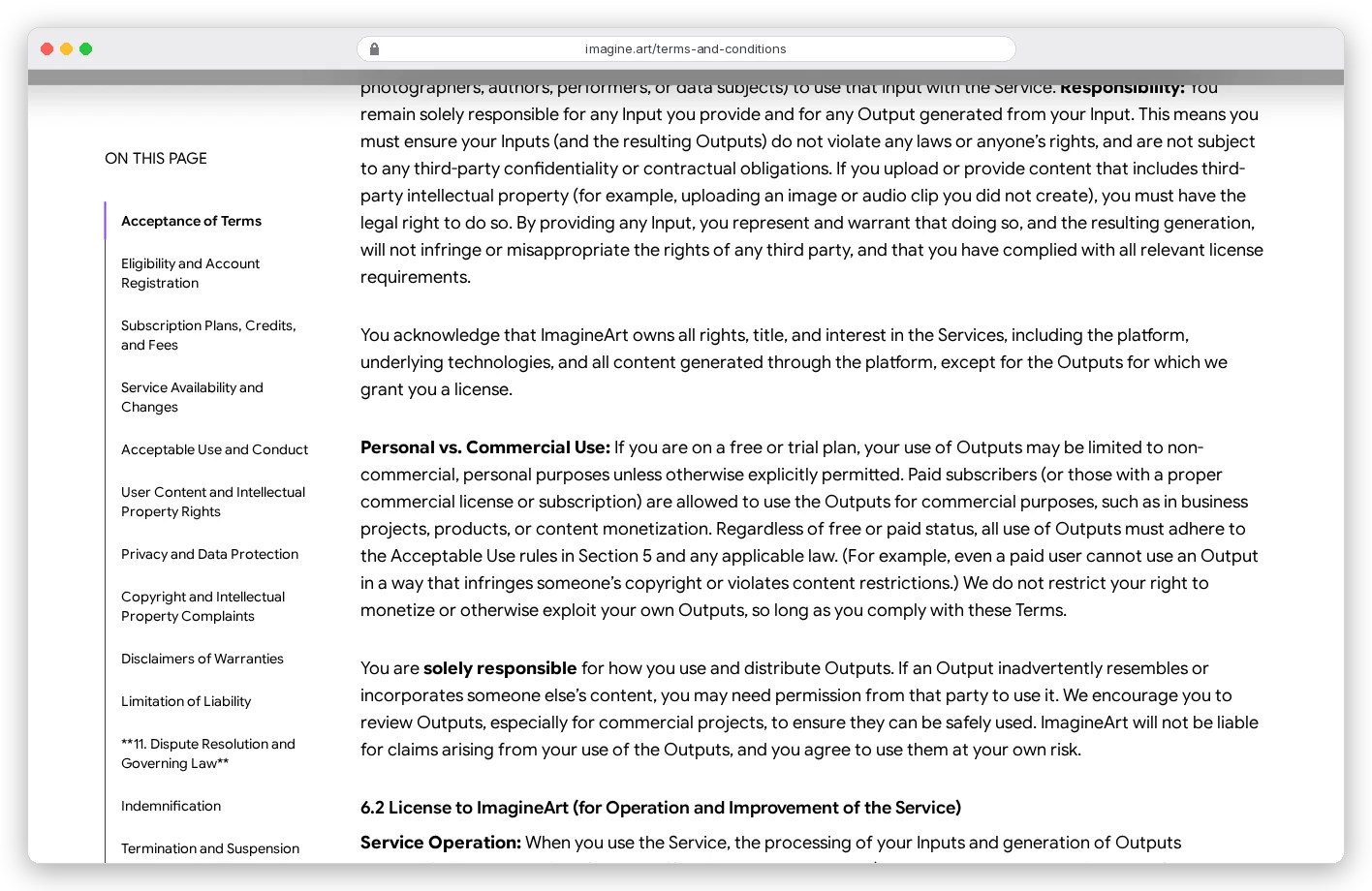
ImagineArt's Terms state that free or trial Outputs may be limited to non-commercial, personal purposes unless explicitly permitted. Paid subscribers may use Outputs for commercial purposes such as business projects, products or content monetization.
The same section says ImagineArt owns the platform and grants you a licence to Outputs. You remain solely responsible if an Output resembles someone else's work.
Their FAQ answers "Can I use ImagineArt-generated content commercially?" with yes for paid subscribers, plus warnings about trademarks and local advertising law. Marketing pages sometimes say "you own what you make." The Terms' licence wording is safer to quote in a client brief. For a fuller product take, see the ImagineArt review.
ImagineArt is the affiliate link if you want their current paid tiers.
OpenArt: commercial use starts at Plus
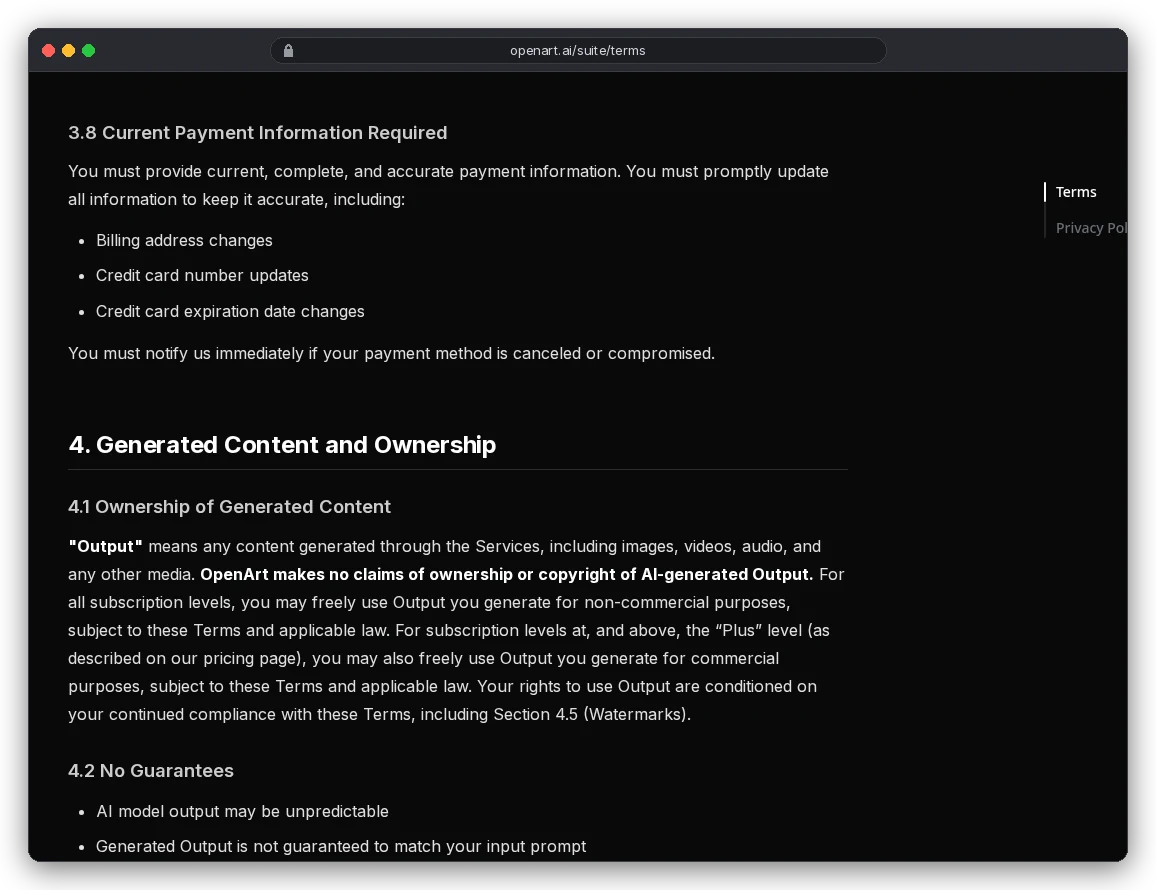
OpenArt's Terms (Last Updated 30 July 2026) are blunt. OpenArt makes no claims of ownership or copyright of AI-generated Output. Every subscription level may use Output non-commercially. Commercial use is for subscription levels at and above Plus, as described on the pricing page, and subject to the Terms including watermark rules.
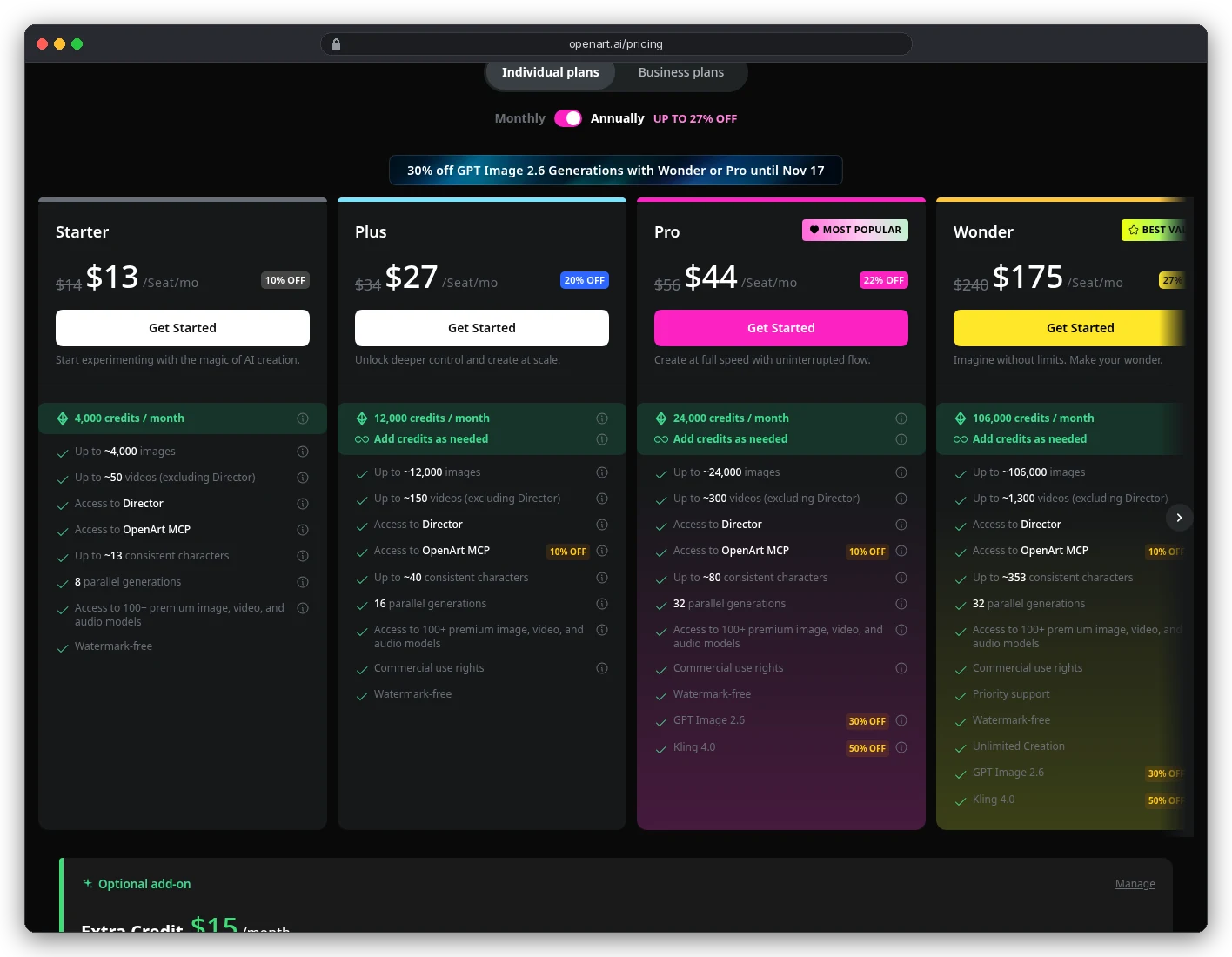
On the pricing page on 5 November 2026 (annual individual plans), Plus, Pro and Wonder list "Commercial use rights." Starter lists watermark-free generation but does not list commercial use rights in that feature row.
Free-plan Output may carry a watermark. Under §4.5 you must not remove it unless a paid plan without watermarks applies or OpenArt gives written permission.
OpenArt also disclaims warranties that Output is original or non-infringing, and says its optional "IP Safety Check" is not guaranteed accurate. Useful as a screen. Not a substitute for clearance on a big campaign.
How other major tools phrase it
Comparison table from primary terms we opened on 5 November 2026. Always re-read before a launch; vendors edit these pages without a press release.
| Tool | Commercial permission (contract) | Ownership language | Catch to check |
|---|---|---|---|
| ImagineArt | Paid subscribers; free/trial generally personal/non-commercial | Licence to Outputs; platform owned by ImagineArt | User responsible for third-party resemblance |
| OpenArt | Plus and above | No ownership/copyright claim on Output | Watermarks on free; Starter lacks commercial row |
| Midjourney | Subscriber commercial use with exceptions | "You own" Assets to fullest extent under law | Company over $1M USD revenue needs Pro or Mega; upscales of others' images stay theirs |
| OpenAI (ChatGPT / Images) | Subject to Terms and Usage Policies (no separate paid-only commercial gate in the consumer Terms we read) | You own Output; OpenAI assigns its interest, to extent law allows | Must not present Output as human-generated when it was not; similar Output may go to others |
| Google Gemini API | Comply with law; API terms aimed at professional use | "Google won't claim ownership" over generated content | Same/similar content may be generated for others; attribution may apply when CitationMetadata returns |
| Adobe Firefly | Non-beta features: commercial projects allowed per Adobe's business FAQ; beta unless product says otherwise | Input/Output are your Content; may not be IP-protectable | Keep Content Credentials; partner/non-Adobe models follow their own terms; IP indemnity only on eligible enterprise/teams plans |
Midjourney's commercial help article (opened 5 November 2026) repeats the ownership claim, the other-user upscale rule, and the $1M / Pro-or-Mega rule. It also says the company cannot advise on copyright and points you to a lawyer. We could not re-capture that page as a screenshot (Cloudflare bot check). The wording above is from the live help article text.
Google's Gemini API Additional Terms say: "Google won't claim ownership over that content," and that Google may generate the same or similar content for others. That is a platform statement about their claim, not a promise the image is unique worldwide.
For product-shot workflows that lean on these tools, see AI product photos.
What the U.S. Copyright Office says
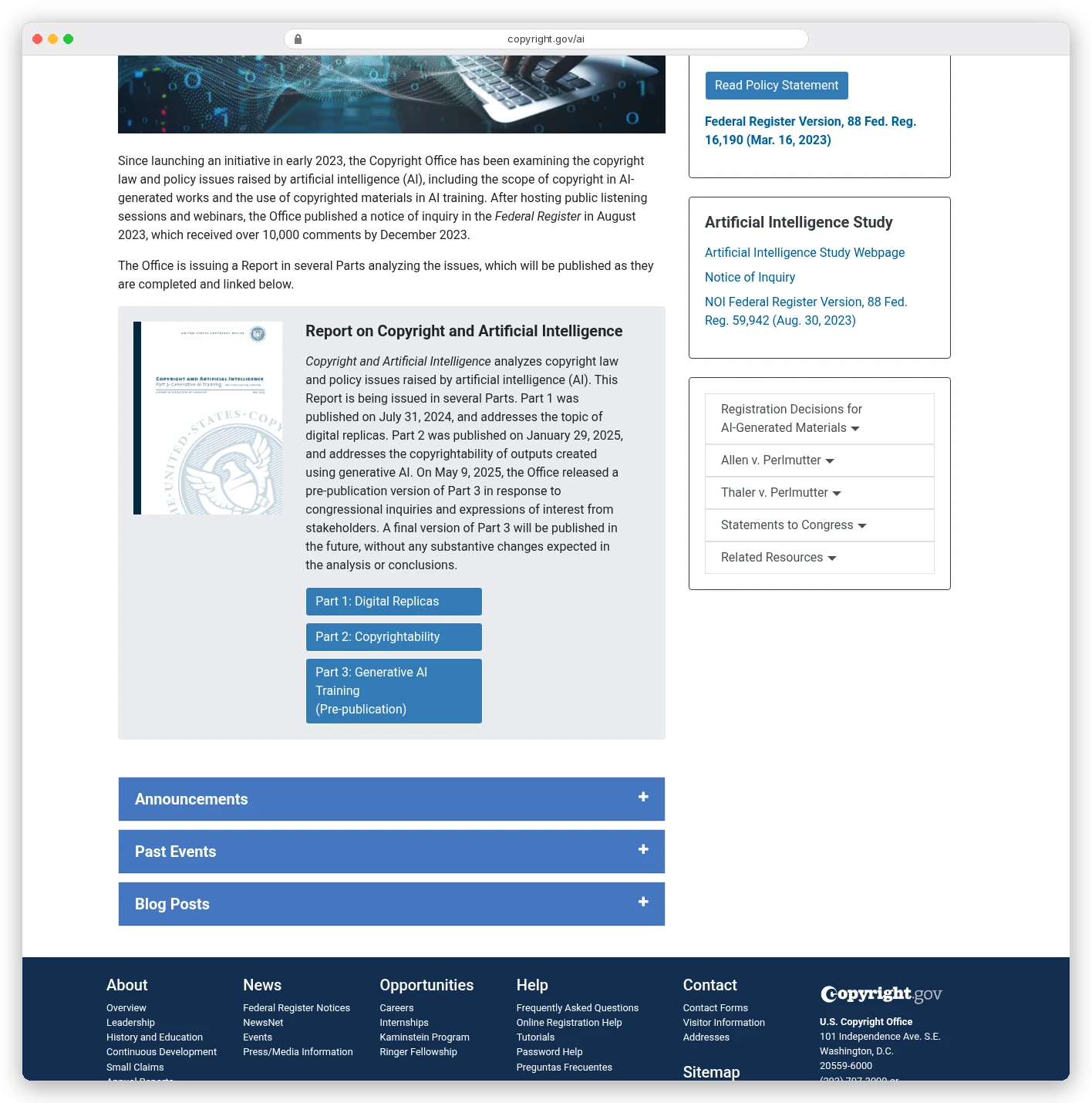
Permission from a vendor is not the same as a copyright registration. The U.S. Copyright Office's public hub at copyright.gov/ai collects its AI reports.
Part 2, on copyrightability of generative AI outputs, was published 29 January 2025. The March 2023 registration guidance (88 Fed. Reg. 16,190) is still the Office's statement of policy for applications that include AI material.
From that March 2023 guidance, in the Office's own framing:
- Copyright protects material that is the product of human creativity. Purely machine-determined expression is not registered.
- When a system receives a prompt and produces the expressive elements itself, the Office's position (based on then-current tools) is that those elements are not the product of human authorship and must be disclaimed on a registration application.
- A human may still claim copyright in creative selection, coordination or arrangement of AI material, or in creative modifications that themselves meet the originality standard. Protection covers the human-authored aspects, not the AI bits.
Part 2's published conclusions, as summarised on the Office's AI page and report materials, land in a few points. Existing law can handle these questions. AI used as an assistive tool does not bar protection for human expression. Prompts alone do not provide sufficient control under current generally available technology. The Office did not recommend a new sui generis right for AI-generated content.
We are not restating court holdings here. The Office's own 2023 guidance footnote discusses its review of a graphic novel that mixed human-authored text with Midjourney images. The Office treated the human-authored aspects as protectable and the individual AI images as not. For case outcomes, read the primary court or Office documents, not a blog paraphrase.
If you sell in the U.S. and care about registration, plan for human contribution you can describe. Composition choices. Substantial edits. Selection among many outputs. Layout with your photography or type. Keep a record. Prompts alone are a weak story under the Office's published view.
Practical checklist before you ship
- Write the use in one sentence (client deliverable, paid ad, merch, internal slide).
- Confirm the plan that was active when the image was generated, not the plan you upgraded to later, unless the Terms say upgrades apply retroactively.
- Save a dated copy of the Terms and pricing feature list for that day.
- Check watermarks, Content Credentials and "do not remove metadata" rules.
- Scan for logos, celebrity likenesses, distinctive branded products or copyrighted characters you did not clear.
- If a third-party model runs inside a host app (Adobe's Non-Adobe Models section is the pattern), read that model's terms too.
- For anything you need to enforce against copycats, ask counsel whether your human edits support a U.S. registration claim.
- Put the risk split in the client contract: who clears trademarks, who warrants originality, what happens if a platform takes the image down.
Prompt craft still matters for quality even when rights are fine. Our AI image prompt guide covers that side.
When not to rely on AI images
Skip or clear carefully when:
- You need a registration you can take to court over a near-copy of a barely edited export.
- The brief requires a real person's likeness, a protected character or a competitor's trade dress.
- A brand or retailer demands photographer-style chain of title and model releases AI cannot invent.
- You are on a free or starter tier whose Terms reserve commercial use for a higher plan.
- The host tool runs a partner model whose commercial rules you never opened.
Stock photography, a commissioned illustrator or your own shoot still win those briefs. AI is faster for drafts, variants and low-risk social filler when the plan and the use line up.
Which path should you take?
If you only need vendor permission for ads or client work, match the plan first. ImagineArt paid. OpenArt Plus+. Midjourney with the revenue and plan catch. OpenAI, Google or Adobe under their current terms. Then keep records.
If you also need copyright you can register in the U.S., budget time for meaningful human authorship. Read copyright.gov/ai before you promise exclusivity in a contract.
For a logo, a mascot you must own for years, or a campaign that cannot survive a takedown, get counsel involved before the first generate click.