Most cold emails get deleted before the second sentence, and not because cold email is dead. The first two lines could have gone to anyone: a greeting, the sender's company name, a paragraph of features, a calendar link.
Learning how to write cold emails that get replies is mostly learning what to leave out. The ones that work are short, about one problem, and end with a question the reader can answer in a line.
Then there's the number everyone quotes. Ask three large datasets for the "average reply rate" and you get 0.74%, 1.61% and 3.43%.
All three are correct, and only one kind of number is worth planning with. We'll get to which.
Sources checked on 22 October 2026: benchmark reports by Instantly, Smartlead and Emailchaser, Google's and Yahoo's sender rules, the FTC, the UK ICO and the GDPR text. We didn't send a campaign for this post, and every example email uses made-up companies.
What a cold email that gets replies looks like
Five parts, under 80 words, plain text:
- A subject line that names their situation, not your product.
- One opening line that says why you're writing to this person now.
- One or two sentences on the problem you solve, and proof.
- One question they can answer without opening a calendar.
- A real signature, your postal address and an easy way to say no.
The length isn't a style choice. Instantly's 2026 benchmark report says its best campaigns keep emails under 80 words, with "a single call-to-action and problem-first positioning".
Smartlead's data, from more than 850 million emails, is blunter. First emails under 50 words earned a reply every 68 contacts, while emails of 100 to 149 words needed 97.
So the padded email needs about 40% more people for the same reply.
How do you fit a useful email into 60 words? You do most of the work before you type.
How to write cold emails, step by step
1. Pick one segment and one problem first
A cold email can only be as specific as its list. Mix a 10-person agency with a 2,000-person freight firm and no sentence is true for both. So you write the vague one.
Write two lines before the email. Who exactly is it for? And what one problem do they have that you fix?
"Finance ops leads at freight companies of 50 to 500 people who key supplier invoices by hand" is a segment. "SMBs" isn't. If you can't write a different first line for a group, it isn't its own segment.
Building the list is a separate job. Our guide to finding leads in Apollo turns an ideal customer profile into filters. Here we assume you have 50 to 300 people who share a problem, and a blank email.
2. Write a subject line a colleague might send
The subject line has one job: get the email opened by the person it's about. Instantly's report says subject lines "that reference a specific problem, outcome, or situation relevant to the prospect's world get opened".
Two rules come from outside sales. The FTC: "The subject line must accurately reflect the content of the message." And Google says not to start a subject with "Re:" or "Fwd:" unless it really is a reply or forward. The fake-reply trick is out.
| Weak | Better | Why |
|---|---|---|
| Quick question | invoice backlog at northwind | Their company, their problem |
| Ledgerline x Northwind partnership | the two AP roles you posted | About them, not you |
| Re: our conversation | kettle & clay checkout on mobile | There was no conversation |
| Save 50% on accounts payable!! | keying invoices into netsuite | No claim to defend, nothing that reads as an ad |
Lowercase, two to five words, specific. It looks like internal mail, and that's the point: it reads like something a person typed.
3. Open with the reason you're writing to them
This is where personalisation lives, and where most of it goes wrong. "Hi [first name], loved your recent post" is a merge field pretending to be research. The reader can tell.
Apollo's cold email guide puts it best: "Personalization should explain why your message matters to the recipient." A name helps only when it supports a real reason. The guide also says to "use details you can verify".
Here's how personalisation ranks, weakest first:
- Merge fields (name, company, city): necessary, but nobody reads them as effort.
- Role-level: the problem everyone in their job has. Honest, and enough for a broad segment.
- Trigger events: a job posting, a funding round, a launch, a new tool in their stack. These answer "why now?"
- Your own observation: something you saw on their site, in their docs or in their product. The hardest to fake, so it lands best.
A good opener ties the trigger to the problem: "Saw you're hiring two AP clerks in Columbus. Teams usually add AP headcount when invoice volume outgrows the inbox." The second sentence is what makes the first one relevant.
Finding triggers by hand takes about five minutes a prospect, so a list of 200 eats two working days. That's why people automate the research. Our guide to turning websites into LLM-ready data shows how to pull a prospect's pages into notes you can write from.
4. Make the case in two sentences
Then comes the offer, in two sentences at most. One says what you do in terms of their problem. The other proves it.
Proof is where people make things up. Use only what you can back up. A customer who agreed to be named, a number from a real project, a link to work you shipped.
No proof yet? Describe the mechanism exactly: "reads invoices from the AP inbox and drafts the NetSuite entry for approval". Precise beats impressive.
AI writers are fine for a first draft. Apollo's own guide says to check each one for accuracy, relevance and voice before it goes out. A wrong fact in line two loses the reply.
5. End with a question they can answer in one line
Instantly says top performers use "binary questions or simple requests that require minimal cognitive load". Apollo's guide says "end with a question they can answer". Both are telling you to drop the calendar link from email one.
Why? A calendar link asks a stranger for 30 minutes. A question asks for one word.
- Interest: "Is this worth a look before those hires start?"
- Permission: "Want me to send the 90-second video?"
- Routing: "Are you the right person, or is it someone in ops?"
Sign off like a person: name, company, postal address, and a line like "Not relevant? Reply 'no' and I won't email again." The legal section explains why the last two aren't optional.
Three example cold emails, annotated
These are worked examples for hypothetical companies. The bracketed line is where your real proof goes. We left it blank on purpose rather than invent a result.
Example 1: software, using a hiring trigger
Subject: invoice backlog at northwind

Hi Dana,

Saw Northwind is hiring two accounts payable clerks in
Columbus. Teams usually add AP headcount when invoice
volume outgrows the inbox.

Ledgerline reads supplier invoices from email and drafts
the NetSuite entry for someone to approve.
[One line of proof: a freight customer and a number you can back up.]

Is it worth a look before those hires start?

Priya Shah, Ledgerline
[Postal address]
Not the right person? Reply "no" and I won't email again.
About 60 words before the signature, once your proof line is in. The open roles explain "why now" and the second sentence explains "why us". Dana can answer with "yes", "no" or a forward.
Example 2: an agency, using its own observation
Subject: kettle & clay checkout on mobile

Hi Mia,

I added a mug to the cart on my phone last night, and the
shipping cost only appeared on the final checkout step.
If it were my store, I'd want to know.

We fix checkout flows for Shopify brands. I recorded a
90-second screen video of what I saw.

Want me to send it?

Tom Reyes, Fernhill Studio
[Postal address]
Not interested? Reply "no" and I'll leave it there.
The offer is a gift that costs her nothing. There's no link yet. The video goes out only if she says yes.
Example 3: a freelancer, using a public change
Subject: parcelbase webhooks quickstart

Hi Lena,

Your changelog says webhooks went live last week, but the
quickstart still shows the polling example. New users
following it will build the old way.

I write API docs for developer tools.
[One line of proof: a docs project you shipped, with a link.]

Should I draft the webhooks quickstart, or is someone
already on it?

Arjun Mehta
[Postal address]
Wrong person? Tell me and I won't follow up.
The second half of the question gives Lena an easy way to say no without ignoring you. People answer emails that are easy to answer.
Look at what all three skip: "I hope this finds you well", "my name is", the company history. Each could only have gone to one person.
How many follow-ups should you send?
More than most people do. Emailchaser tracked 55,329 people through three-email sequences. 0.81% replied to the first email, 1.38% had replied after the first follow-up, and 1.61% after the second.
The two follow-ups found almost as many repliers as the first email. Yet 58% of the campaigns (334 of 576) never sent one.
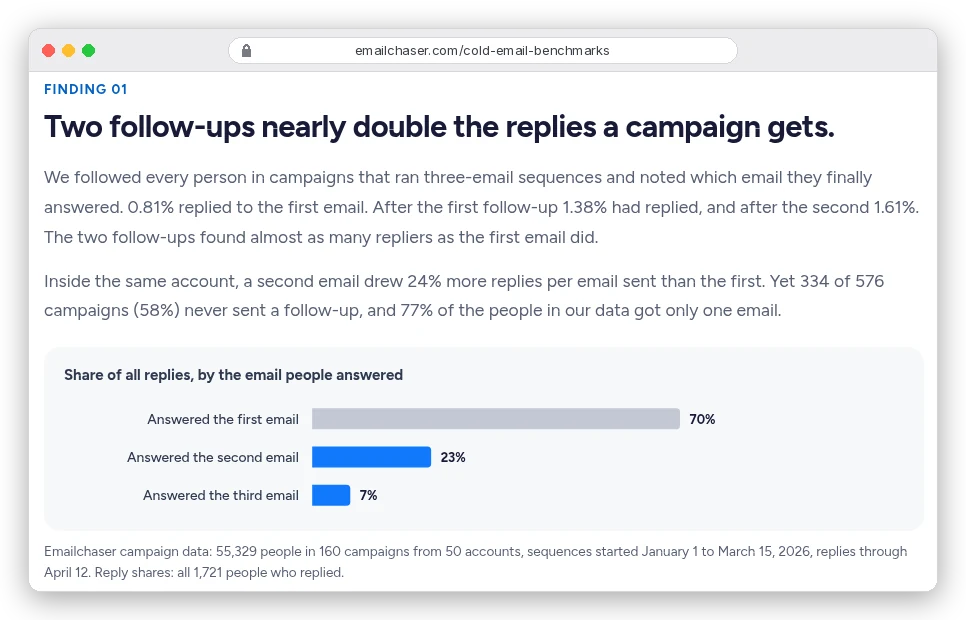
The other reports point the same way. Instantly says 58% of replies come from step one and 42% from follow-ups, and recommends 4 to 7 touchpoints, 3 to 4 days apart. Smartlead shows the decay: 85 contacts per reply for email one, 303 for email seven.
So where do you stop? Around four emails.
The seventh still earns the odd reply. But every extra email to someone who isn't interested risks a spam report, and those have a hard limit (more on that below).
Timing has data too. Emailchaser found 79% of replies arrive within 24 hours and 91% within three days. Wait at least three days, because by then almost every reply that email will get is in.
A four-email sequence you can copy
Send every follow-up in the same thread, as a reply to your last email. That makes the "Re:" genuine, which is what Google asks. Instantly also says its best second emails "feel like replies, not reminders".
Each one adds a new angle. None says "just checking in".
| Day | Its job | |
|---|---|---|
| 1 | The first email (Example 1) | Trigger, problem, one question |
| 4 | Follow-up 1, in thread | A second angle on the same problem |
| 8 | Follow-up 2, in thread | Something useful: a video, a teardown, a resource |
| 14 | Follow-up 3, in thread | Close the loop politely |
Here's what Dana would get if she didn't reply to Example 1:
Day 4
Hi Dana, one more thought. When AP grows by hiring, the work
per invoice stays the same: open the PDF, key it in, chase
the approval. Ledgerline removes the keying step.
Worth 15 minutes to see it on three of your own invoices?

Day 8
Dana, here's a two-minute video of one invoice going from
the inbox to a NetSuite draft: [link]. No signup needed.
If this isn't a priority this quarter, say so and I'll stop.

Day 14
Hi Dana, I'll assume the timing isn't right and close this
out. If invoice volume becomes a headache later, this
thread will still reach me.
Priya
The gaps grow from 3 to 4 to 6 days, so the sequence slows as interest fades. The only link arrives on day 8.
The last email gives her a clean exit. That's what draws the "not now, try us in Q1" replies you'd otherwise never see.
Stop the sequence the moment anyone replies, "no" included. Then put that "no" on a suppression list every future campaign checks.
What reply rate should you expect?
Back to the three numbers from the top. All three are real. They just divide by different things.
| Report | What it counts | Typical | Top 10% |
|---|---|---|---|
| Instantly (2025 data) | All replies, follow-ups included, divided by emails sent; an average | 3.43% | 10.7%+ |
| Smartlead (850M+ emails) | Replies per contact, median sender with 500+ emails | 0.74% | 2.63% |
| Emailchaser (Jan-Mar 2026) | People who wrote back within three emails; auto-replies and unsubscribes removed | 1.61% | Not published |
Two things move the number. A few excellent senders pull an average up but not a median, a point Smartlead makes in its own FAQ. And a rate per email sent isn't a rate per person, which is the one you care about.
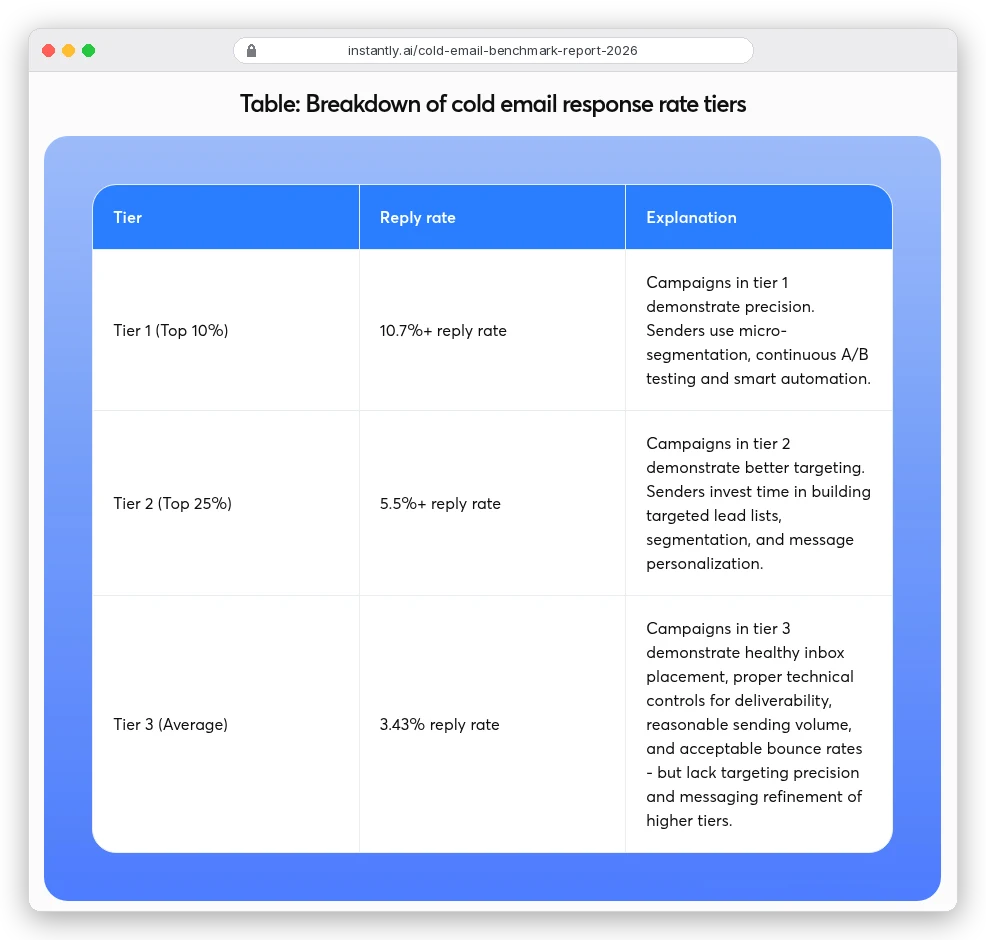
That's the answer to the question at the top: plan per person. Smartlead's typical sender gets one reply per 135 people, and its top 10% one per 38. Emailchaser's three-email sequences got about one per 62.
For a new list and a new offer, we'd budget for about one reply per 100 people, some of them a "no". That's our reading of the three reports, not a promise.
It also means 200 well-chosen prospects is a sensible first test. Two replies from 20 people tell you nothing.
And ignore open rates. Google says it doesn't track them and can't verify the ones third parties report. Smartlead and Emailchaser leave opens out of their reports, because mail apps that preload images inflate them.
Count replies per person, positive replies, bounces and spam complaints. The last two have hard limits.
The inbox rules your copy has to follow
Deliverability is mostly setup: domains, authentication, warm-up. Our Instantly vs Apollo comparison covers mailbox limits and warm-up costs. But a few of Google's and Yahoo's rules land directly on what you write.
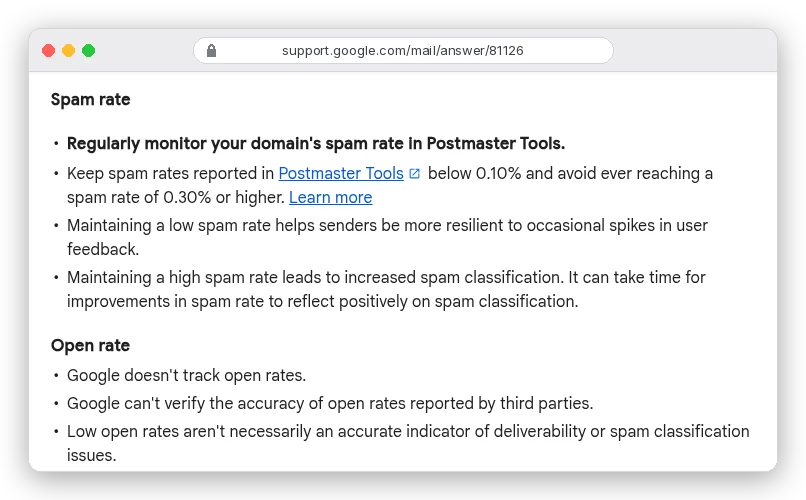
- Spam complaints: Google says stay below 0.10% and never reach 0.30%. Yahoo's ceiling is 0.3%, which is three reports per 1,000 emails.
- Authentication: both want SPF or DKIM from every sender. Above 5,000 messages a day to Gmail, add DMARC and one-click unsubscribe on marketing mail.
- Unsubscribes: Yahoo asks bulk senders to honour them within 2 days.
- Honest formatting: no fake "Re:", no text hidden with HTML or CSS, and links that are "visible and easy to understand".
- Bounces: Instantly and Smartlead both put the danger line at 2%. Emailchaser saw unverified addresses bounce 4.6% of the time against 0.6% for verified ones. Verify every address first.
You're probably thinking: Google also says not to email people who didn't sign up. It does, and cold email lives in tension with that rule.
The practical answer is small volumes, tight targeting and an easy way out. Someone who can reply "no" in two seconds has less reason to press "report spam".
Is cold email legal? CAN-SPAM, PECR and GDPR in brief
Generally yes, with conditions that differ by country. This is a plain-English summary of official guidance, not legal advice. Talk to a qualified lawyer about your situation, especially before emailing into a new country.
United States: CAN-SPAM
The FTC's CAN-SPAM compliance guide says the law "makes no exception for business-to-business email". For commercial messages it requires:
- Accurate "From", "To", "Reply-To" and routing information.
- A subject line that reflects the content.
- A clear and conspicuous disclosure that the message is an ad (the FTC says the law gives "a lot of leeway in how to do this").
- Your valid physical postal address.
- A clear way to opt out, honoured within 10 business days and working for at least 30 days after you send.
You also "can't contract away your legal responsibility" by hiring someone to send for you. Each email that breaks the law can carry its own penalty. Yahoo even tells senders to follow CAN-SPAM "regardless of where in the world you're sending your mail".
United Kingdom: PECR
The ICO's guidance says you can email "any corporate body" without prior consent: a company, a Scottish partnership, an LLP or a government body. But "sole traders and some partnerships are treated as individuals", so they need consent or an existing customer relationship.
The ICO also says to keep a "do not email" list of businesses that object. Emailing a named employee (firstname.lastname@) brings data protection rules in too. And its page notes the guidance is under review after the Data (Use and Access) Act, so check it again before relying on it.
European Union: GDPR
A named work address is personal data. The GDPR says direct marketing "may be regarded as carried out for a legitimate interest" (Recital 47). But people can object "at any time" (Article 21), and then you stop.
Article 14 bites hardest on cold email. If you didn't get someone's data from them, you must tell them certain things, including where you got it, "at the latest at the time of the first communication".
Many EU countries add their own rules on marketing email, which is where local advice earns its fee.
The footer in our examples (a real name, a postal address, an easy "no") is the minimum that respects all three. It costs you one line.
Before you press send: a checklist
- Can you name the segment and its shared problem in one sentence?
- Does the subject describe their situation, with no fake "Re:"?
- Is the first line true only for this person or company?
- Could you back up the proof if they asked?
- Is it under 80 words, plain text, with no link in email one?
- Does it end with a single question?
- Are your name, company, postal address and opt-out line in the footer?
- Is every address verified, and is the suppression list loaded?
- Are three follow-ups written, each with a new angle, three or more days apart?
- Will you count replies per person, not opens?
Where to start this week
Never sent cold email? Pick one segment and write Example 1's structure for your own offer. Send it to 50 people from one warmed-up mailbox, and read every reply yourself before you change a word.
Already sending, with replies near zero? Fix the first line before anything else. Swap merge-field openers for a trigger or an observation, cut to 60 words, and trade the calendar link for a question.
Choosing tools for a team? Read the Instantly vs Apollo breakdown first. Apollo earns us a commission, and it still isn't the cheapest pick for a team that only emails: Instantly is.
Apollo makes more sense when the same people also call and want contact data in one place.
Whoever you are, judge the result at 200 people, not 20. Below that, one lucky reply looks like a strategy.