You record ten minutes of yourself on a laptop mic and upload the lot. The clone that comes back sounds like you in a stairwell.
It breathes where you breathed. It hums the fridge. And it gets weirder the moment you ask it to sound excited.
AI voice cloning is mostly a recording problem. The fix depends on which clone you're making: an instant one from a minute or two of audio, or a professional one trained on hours.
One rule in ElevenLabs' own docs runs opposite to what most guides tell you. We'll get to it in step 2.
Written from ElevenLabs' docs, help centre, pricing page and use policy, Fish Audio's cloning docs and the legal texts linked below, checked on 26 October 2026. We didn't create a clone for this guide; the examples are hypothetical.
What you'll end up with, and which clone gets you there
By the end you'll have a voice in your account that reads any script in your voice, plus the original recordings saved somewhere safe. You'll also know which uses of it are fine and which ones cross a line.
The first decision is the type of clone. ElevenLabs offers two, and they aren't fast and slow versions of the same thing. Its explainer on how cloning works says an instant clone uses your audio as a live reference, with "no training process".
A professional clone is different: it "fine-tunes the model on your audio samples."
Here's how the two compare on the things that change your plans, per ElevenLabs' docs and pricing page on 26 October 2026:
| Instant clone (IVC) | Professional clone (PVC) | |
|---|---|---|
| Audio you need | 1-2 minutes of clean speech | 30 minutes minimum, 2-3 hours ideal |
| Ready in | Straight away | Usually 3-6 hours, up to 24 |
| Whose voice | Anyone you have consent from | Only your own |
| Identity check | You confirm rights and consent | A live voice check you read aloud |
| Cheapest plan | Starter, $6 a month | Creator, $22 a month |
That "whose voice" row surprises people, and it decides more than the price does. We'll come back to it.
What you need before you record
Four things, and only one of them costs money:
- A paid plan on a cloning tool. The examples here use ElevenLabs because its cloning docs are the most detailed. If you're still choosing, our ElevenLabs vs Fish Audio comparison covers price per minute.
- A microphone. ElevenLabs says "any microphone will work" and recommends an XLR mic into an audio interface for professional clones. Fish Audio's docs are happy with a phone voice recorder on a stable surface.
- A quiet room with soft surfaces.
- A script in the style you want the clone to speak. If the clone will narrate courses, read course material, not a casual chat.
On the plan: the free tier won't clone at all. ElevenLabs' pricing table marks Instant Voice Cloning from Starter and Professional Voice Cloning from Creator, which includes one professional clone slot.
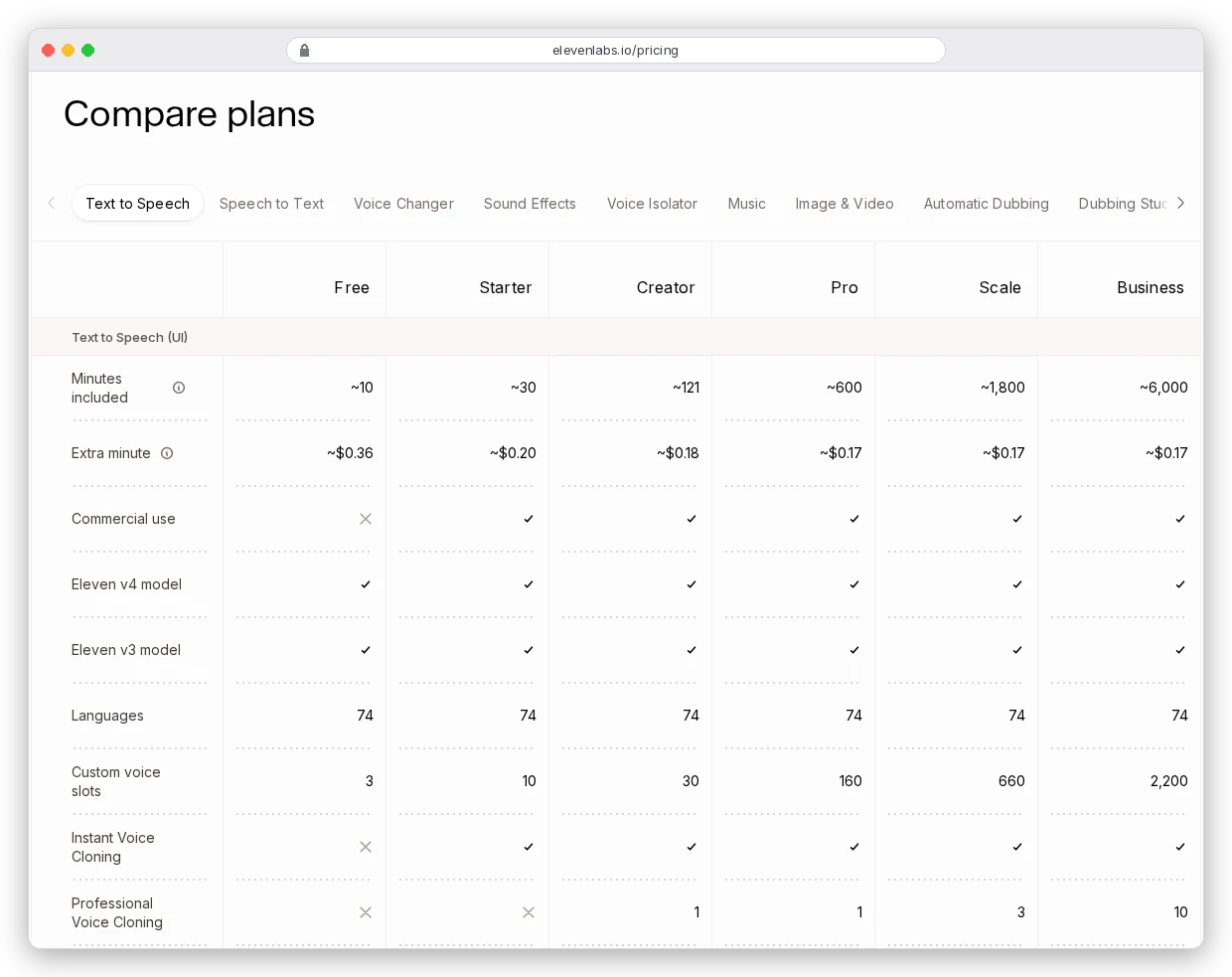
List prices on that page were $6 a month for Starter and $22 for Creator. ElevenLabs was also showing a first-month discount "Until Nov 1" ($1 for Starter, $11 for Creator), so check the page if you're reading this later.
The free plan also has no commercial licence. If the clone will voice anything you sell or monetise, generate the final audio while subscribed.
Step 1: Make the room quieter than you think it needs to be
Here's the part most people rush. A clone copies the recording, not just the voice.
ElevenLabs puts it bluntly: "The AI will attempt to mimic everything it hears." That means your pace, accent and breathing, "as well as noise and mouth clicks." Echo from a bare room becomes part of your voice.
So before you press record:
- Pick the smallest room with the most soft stuff in it. Fish Audio suggests a bedroom with curtains and carpet, or the inside of a parked car.
- No duvet booth? ElevenLabs suggests a temporary one: "a thick duvet or quilt to dampen the recording space."
- Turn off fans, air conditioning and anything with a hum. Fish Audio lists fridges by name.
- Sit about two fists from the mic (ElevenLabs) or a hand's width (Fish Audio), and use a pop filter if you have one.
Then do a 20-second test take and listen on headphones. If you can hear the room, so will the clone.
Levels matter too. ElevenLabs' target is -23 to -18 dB RMS, with a true peak of -3 dB. In plain terms: a steady, healthy level, with peaks well clear of the red.
Step 2: Record the right amount, which isn't "as much as possible"
This is the rule from the intro. For an instant clone, more audio stops helping fast.
ElevenLabs' instant cloning guide says to record at least a minute. Then it adds: "Avoid recording more than 3 minutes, this will yield little improvement and can, in some cases, even be detrimental to the clone."
Its help centre goes further. It has seen 30-second samples give "excellent results" and 10-minute uploads do worse.
Why would more audio hurt? ElevenLabs doesn't spell it out, but its docs keep coming back to consistency. An instant clone uses your recording as its reference every time it speaks. Ten minutes from three sittings gives it three rooms, three moods and three mic positions to copy.
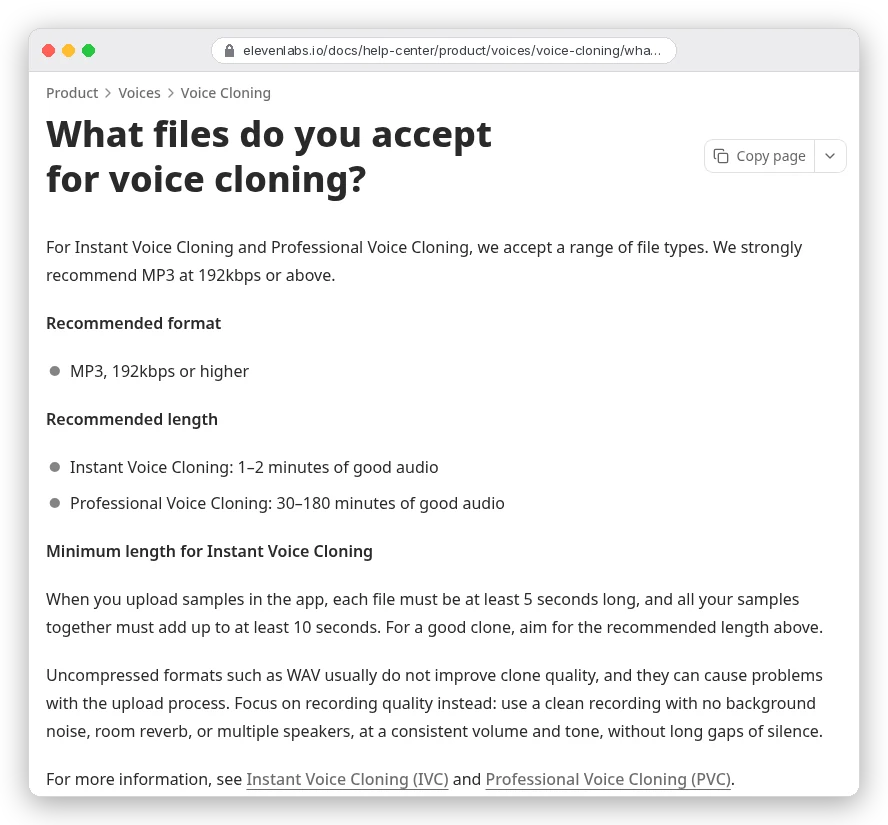
The hard floor is low: each file must be at least 5 seconds and all of them together at least 10. The target is 1-2 minutes of one consistent take.
Format matters less than you'd expect. ElevenLabs recommends MP3 at 192 kbps or above and says WAV "usually do[es] not improve clone quality" and can cause upload problems. Spend the effort on the room, not the file type.
And perform the way you want the clone to sound. Talk "in a slow, monotone voice," the docs warn, and "that is what the AI will mimic." Reading flat to be safe gets you a flat clone.
Professional clones flip all of this. They want a lot more audio, and that's step 4.
Step 3: Create the instant clone
In the ElevenLabs dashboard, open Voices, click the plus icon and choose Instant Voice Clone. Upload your file or record straight into the browser.
Before you save, you name the voice and confirm you have "the right and consent to clone the voice." On an instant clone, that declaration is the safety check.
The voice is usable as soon as you save it, under My Voices. Three things to know before you build anything on it:
- You can't take it with you. ElevenLabs says you "cannot download or export your voice clones as standalone files." Keep your original recordings, because they're the only way to rebuild the clone, and even then "each clone will sound slightly different."
- Slots are rationed by plan: 10 custom voices on Starter, 30 on Creator. Downgrade and the extra voices stay in your account but locked until you upgrade again.
- An instant clone can be shared only inside your workspace. Only professional clones can go in the public Voice Library.
If your accent comes out wrong, the docs say you can't fix that after the fact. Change the samples instead, or move up to a professional clone, which ElevenLabs suggests for "uncommon accents or unique voices."
Step 4: For a professional clone, record hours and pass the voice check
A professional clone is trained on your recordings, so it copies them even more faithfully, flaws included. ElevenLabs says it "will try to replicate all of these elements," from room echo to background music.
The bare minimum is 30 minutes of audio. One part of the guide asks for "at least an hour" and ideally close to three. Another says "closer to 2-3 hours." Aim for two hours and you satisfy both.
That sounds like a lot. Here's what it means in script.
ElevenLabs' pricing table puts 10,000 credits at about 10 minutes of speech, at roughly one credit per character. So 30 minutes of reading is about 30,000 characters of script, and two hours about 120,000. That's roughly a short book read in one steady voice, not a few paragraphs.
Practical rules from the docs:
- Stick to one style. An audiobook clone should be trained on you reading a book "in the tone of voice you want to use."
- Edit out long pauses and "uhm"s first, because "the AI will mimic those as well."
- Upload long sessions as roughly 30-minute files.
- Speech only: professional clones "do not currently support singing."
- No script? The dashboard has a Record yourself option with sample scripts for narration, conversation and ads.
Then comes the voice check. ElevenLabs asks you to read verification lines aloud through your microphone, using the same mic and delivery as your samples.
Read each line once, then press Stop. The help centre says reading a line twice "can cause the verification process to fail."
Fail every attempt and you wait 24 hours, or ask support to reset your attempts.
Training then starts. The docs give different estimates on different pages ("3-6 hours", "between 6-24 hours", "up to 24 hours"), so plan around a day. You'll get an email when it's ready.
Step 5: Test the clone before you trust it
Don't judge a clone on the sample sentence. Write four test lines that look like your real work. Put your brand name in one and a number in another. Make one a question, and one a line that needs energy.
That last one matters most for instant clones. ElevenLabs warns that a voice cloned from calm narration "may sound different when asked to express strong emotion." Upbeat videos from a calm sample? You'll hear the gap here, not after publishing.
Something sounds off? Go back to the recording, not the settings. ElevenLabs' fix is always better, more consistent samples.
Once the clone passes, our step-by-step AI voiceover guide covers pacing, pronunciation and export settings.
Can you clone someone else's voice?
Sometimes, with an instant clone, and only with their consent. Never with a professional clone on ElevenLabs.
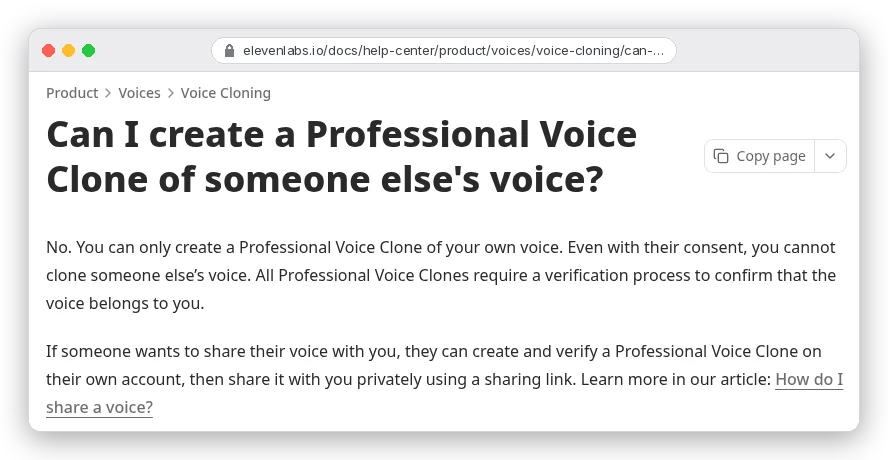
The help centre is direct about professional clones: "Even with their consent, you cannot clone someone else's voice."
If a colleague or voice actor wants you to use their professional clone, they create and verify it on their own account, then share it with you through a private link.
For instant clones, the line is ElevenLabs' prohibited use policy (last updated 9 October 2026). It bans cloning a living person's voice "without their explicit and informed consent or other valid authorization." It also covers deceased people where it's "reasonably likely to cause harm or infringes applicable post-mortem rights."
You're probably thinking a checkbox is easy to tick. True, and ElevenLabs admits its checks "cannot guarantee that the provided recording truly belongs to the requester."
But ticking it isn't the end of the trail. ElevenLabs says all audio from its models "can be instantly traced back to the user responsible." Its policy also treats trying to get around Voice CAPTCHA as a violation in itself.
There are platform-level blocks too. A "no-go voices" safeguard stops clones of "prominent public figures," and ElevenLabs' safety page says it blocks "celebrity and other high risk voices."
If you're cloning someone else, get it in writing. Fish Audio's docs set the same bar: "written permission." A useful consent note says whose voice it is, which tool, what the clone will be used for, for how long, and how they can withdraw.
And if someone clones you without asking, ElevenLabs runs an Unauthorized Use of Voice report form, linked from its use policy.
The legal lines worth knowing
This is not legal advice. Voice cloning laws differ by country and state, and they're changing. Talk to a lawyer before you build a business on a cloned voice, especially someone else's.
Three rules we could open and read in full:
- US robocalls. On 8 February 2024 the FCC ruled that calls made with AI-generated voices are "artificial" under the Telephone Consumer Protection Act. So the consent rules for prerecorded calls apply to a cloned voice, including "prior express written consent" for telemarketing robocalls.
- Tennessee. The ELVIS Act (Ensuring Likeness, Voice, and Image Security Act), in force since 1 July 2024, protects a voice "regardless of whether the sound contains the actual voice or a simulation." Publishing someone's voice while knowing they didn't authorise it can lead to a civil lawsuit.
- The EU. Article 50(4) of the AI Act says people deploying AI that creates audio "constituting a deep fake, shall disclose that the content has been artificially generated or manipulated." Creative and satirical work gets a lighter version: disclose it in a way that doesn't spoil the work.
Not in the US or the EU? The platform rules still apply wherever you are.
The FTC has also warned that scammers use voice cloning "to impersonate business executives." So treat a clone of your own voice like a password.
That points to a practical habit. Don't post your raw training recordings publicly, and keep them where only you can reach them. They're the clean, single-speaker audio a bad actor would want.
Mistakes that ruin a clone
Most failed clones trace back to one of these:
- Uploading 10+ minutes for an instant clone, recorded across different days and rooms.
- Recording in a bare room, then cleaning it with heavy noise reduction that leaves its own artefacts.
- Reading flat "to be safe", then wondering why the clone sounds bored.
- Mixing styles (a podcast clip, a webinar, a voice note) into one professional dataset.
- Verifying a professional clone on a different mic from the one you trained it with.
- Deleting the original recordings, which are the only way to rebuild a clone you can't export.
- Cloning a colleague "because they said it's fine" out loud, with nothing written down.
Weighing other tools before you commit your voice to one account? Our ElevenLabs alternatives guide and the wider roundup of AI audio generation tools cover which ones clone and on which plans.
Which clone should you make?
Want your own voice on short videos or a prototype this week? Make an instant clone on Starter. Record two clean, energetic minutes in one sitting and stop there.
If the voice will carry a course, an audiobook or a brand for years, go professional on Creator. Record two hours in one style and budget a day for training.
If it's anyone else's voice, get written consent first. On ElevenLabs, a professional clone means they make it in their own account and share it with you.